

Key Takeaways for Faster Studying
- Focus on high-yield topics that appear most often in past papers.
- Prioritize your weakest areas that carry the most marks.
- Stop treating all syllabus points as equal.
- Use active recall instead of passive reading to lock in the core 20%.
Why the Pareto Principle Works for Students
The Pareto Principle wasn't actually made for classrooms; it started in economics when Vilfredo Pareto noticed that 80% of the land in Italy was owned by 20% of the population. When you apply this to your GCSE boards like AQA or Pearson Edexcel, you'll realize that exam boards have a pattern. They aren't picking random sentences from the textbook; they are testing specific 'assessment objectives'.
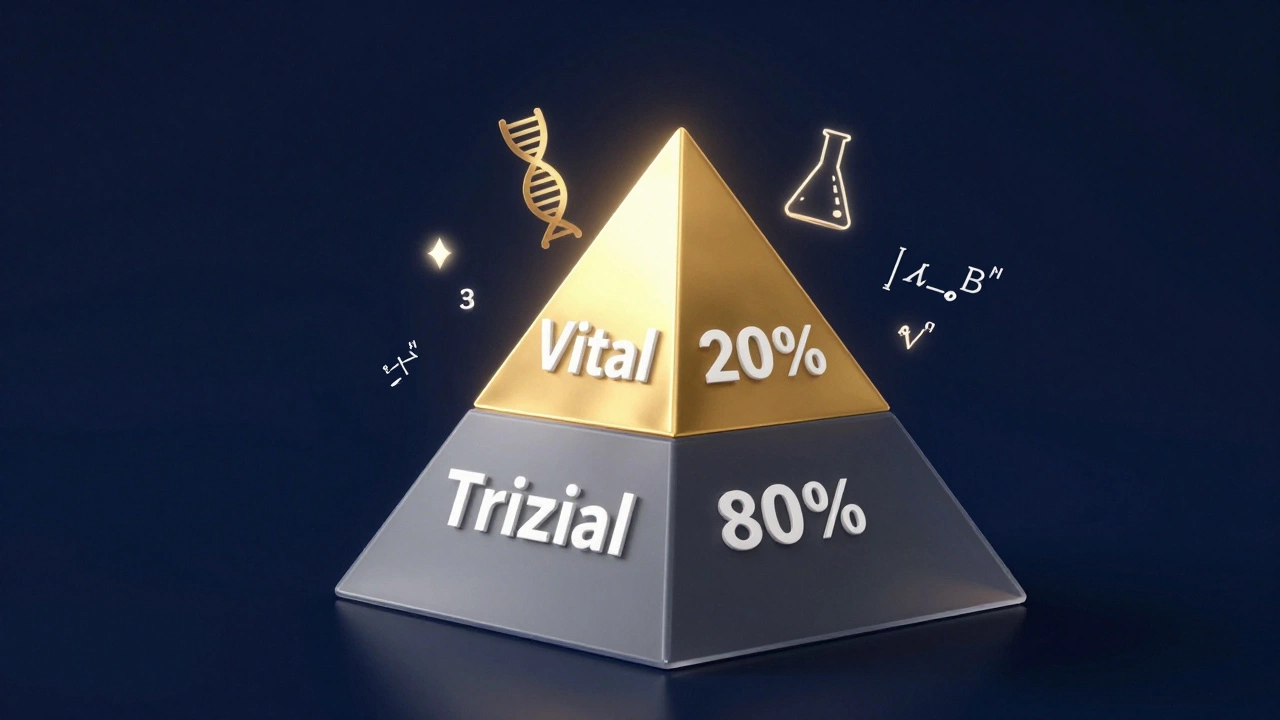
If you look at a biology paper, you'll notice that cell biology and infection and response often carry more weight than some of the smaller, more specific plant processes. If you spend 50% of your time on a topic that only provides 5% of the marks, you're essentially wasting your brain power. By flipping the script and targeting the 'vital few' over the 'trivial many', you can cut your study time in half while keeping or even increasing your grade.
How to Find Your Core 20%
You can't just guess what the important topics are. You need data. The most reliable way to find your high-yield areas is to analyze past papers from the last five years. Don't just do the papers; map them.
- Grab a copy of your official specification (the syllabus).
- Go through three years of past papers and put a tick next to every topic that appears.
- If a topic appears in every single paper (like energy in Physics or the Cold War in History), that is part of your 20%.
- Rank these topics by 'Mark Density'-how many marks are usually awarded for this concept compared to how long it takes to learn.
For example, if you're studying English Literature, you might find that analyzing structure and form in poetry comes up in almost every question. Mastering that one skill (the 20% effort) gives you the ability to answer almost any poetry question (the 80% result), regardless of the specific poem used.
| Feature | Traditional Approach | 80/20 Revision Method |
|---|---|---|
| Content Focus | Linear (Page 1 to Page 100) | High-Yield (Most frequent topics) |
| Time Allocation | Equal time per chapter | More time on high-mark areas |
| Method | Rereading and highlighting | Active Recall and Past Papers |
| Goal | Completion of the book | Maximum mark gain per hour |
Applying the Method to Different Subjects
The 80/20 rule looks different depending on whether you're tackling a science or a humanities subject. In a subject like Maths, the 20% isn't necessarily a topic, but a set of core skills. If you master algebra and trigonometry, you can solve a huge chunk of the paper even if you struggle with the more obscure geometry problems.
In subjects like History or Geography, the 20% usually consists of 'case studies' and 'key themes'. Instead of memorizing every single date, focus on the 3-4 most powerful pieces of evidence for each major theme. If you have a few versatile, high-quality examples that can be adapted to multiple questions, you've hit the Pareto sweet spot.
Let's look at a practical scenario: a student is struggling with Chemistry. They spend weeks trying to memorize every single transition metal property. However, they realize that stoichiometry and bonding appear in every single paper and carry massive marks. By shifting their focus to these core concepts, they jump from a Grade 5 to a Grade 7 because they stopped fighting the 'trivial' details and started mastering the 'vital' ones.
Avoiding the Common Pitfalls
A big mistake students make is thinking the 80/20 method means they should *ignore* the other 80% of the syllabus. That's a recipe for disaster. If you only study the top 20% and the exam board decides to throw in a curveball question from a niche topic, you'll be stuck. The goal is prioritization, not omission.
The correct workflow is to master the high-yield 20% first. Once you're confident and hitting the marks in those areas, you then use the remaining time to skim through the rest. This ensures that if a rare topic comes up, you have a basic understanding, but you've already secured the majority of your marks from the core areas.
Another trap is staying in 'passive mode'. You can't find the 20% by just reading. You need Active Recall. Use flashcards or blurting (writing everything you know on a blank sheet of paper) specifically for those high-yield topics. If you spend your time pretty-printing notes for a topic that rarely appears, you're just procrastinating with a highlighter.

Your 80/20 Action Plan
If you're starting today, don't try to reorganize your whole life. Just take one subject and follow these steps:
- Audit: Spend 30 minutes looking at the last three years of papers. Mark the recurring topics.
- Prune: Look at your current to-do list. Cross off the low-value tasks (like rewriting notes) and replace them with high-value tasks (like timed practice questions).
- Attack: Spend your next three study sessions only on the top three most frequent topics.
- Test: Do a full past paper. Check if your marks improved in the areas you prioritized.
By shifting your mindset from 'how much can I cover' to 'what actually gets me marks', you stop the burnout. Revision becomes a game of strategy rather than a test of endurance. You'll find that you have more free time and less anxiety because you're no longer staring at a mountain of irrelevant information.
Does this method work for all subjects?
Yes, but the '20%' changes. In Maths, the 20% is core skills/formulas. In English, it's analysis techniques and key quotes. In Sciences, it's the most frequently tested biological or chemical processes. The logic remains the same: identify what the exam board loves and master it first.
Will I miss out on marks if I ignore the 'trivial' 80%?
You don't ignore it; you just deprioritize it. Use the 80/20 method to secure your core grade first. Once the high-yield topics are locked in, use your remaining time to cover the rest of the syllabus. This way, you ensure the biggest marks are safe before spending time on the small ones.
How do I know which topics are actually 'high-yield'?
The most accurate way is to analyze past papers from the last 3-5 years. If a topic appears in almost every paper, it's high-yield. You can also check 'Exam Boards' reports or ask your teachers which topics typically account for the most marks in the mark scheme.
Is this the same as 'cramming'?
No. Cramming is trying to shove everything into your head at the last minute. The 80/20 method is about strategic selection. It's actually the opposite of cramming because it allows you to study *less* but more effectively, reducing the need for last-minute panic.
How does this fit with Spaced Repetition?
They work perfectly together. Use the 80/20 method to decide *what* to study, and use Spaced Repetition to decide *when* to study it. Prioritize your high-yield 20% in your flashcard app so you review those critical concepts more frequently than the niche ones.
Next Steps and Troubleshooting
If you're feeling overwhelmed, start with your hardest subject. When you see that you can improve your score by focusing on just a few key areas, it creates a momentum shift that makes the other subjects feel easier.
For the Perfectionist: If you struggle with the idea of 'skipping' things, remember that perfection is the enemy of the grade. It is better to know 20% of the course perfectly than 100% of the course vaguely. Focus on the marks, not the pages read.
For the Procrastinator: If you can't get started, set a timer for 20 minutes and just map one past paper. Once you see the patterns of the exam board, the 'puzzle' of the 80/20 method usually makes the process more engaging than standard reading.
Write a comment