

A-Level Difficulty Estimator
Configure your inputs to generate a personalized study plan estimate.
You’re staring at a textbook that feels like it’s written in ancient Greek. The clock is ticking down to your first A-level mock exam, and the panic is setting in. Everyone warned you that A-levels were a big jump from GCSEs, but nobody prepared you for the sheer volume of content or the depth of critical thinking required. Is it really as hard as people say? Or is it just scary because it’s new?
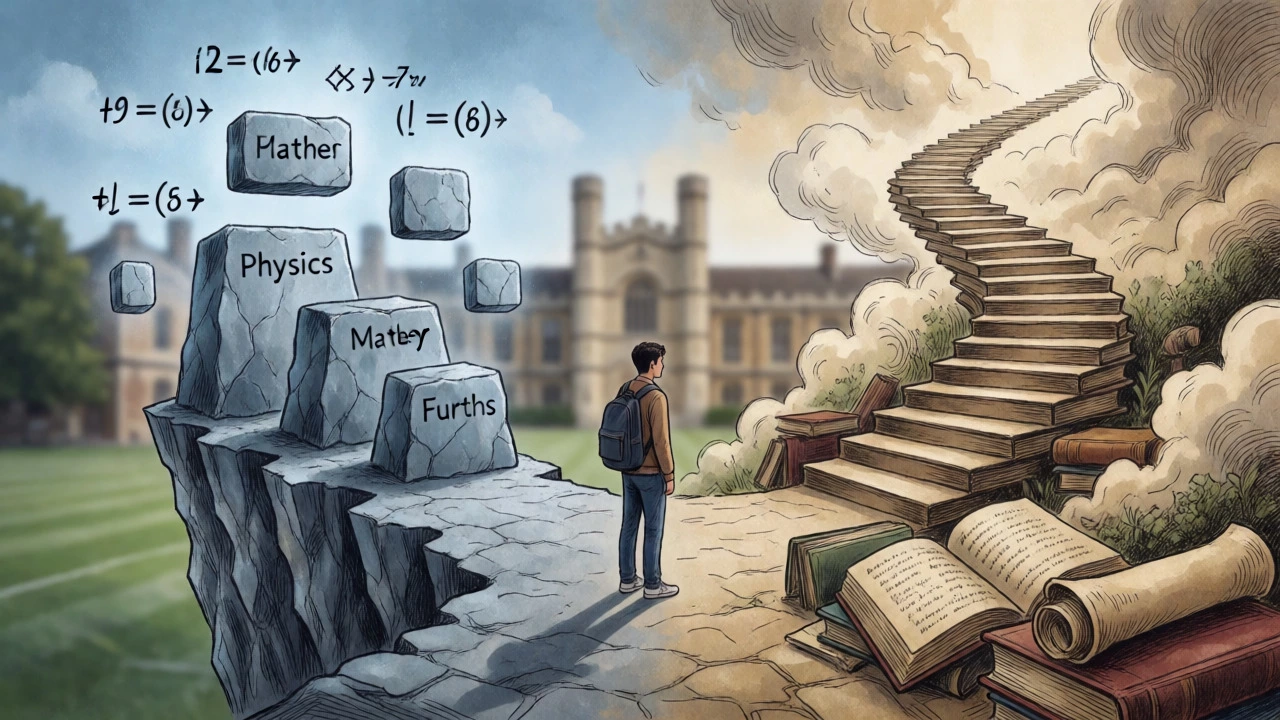
The short answer: yes, it’s harder. But "hard" is subjective. For some students, the jump from memorizing facts to analyzing arguments is a cliff edge. For others, it’s a staircase they climb without breaking a sweat. The difference usually comes down to study habits, subject choice, and how well you manage your time. Let’s break down what actually makes A-levels difficult, which subjects are notoriously tough, and how you can survive (and thrive) without burning out.
The Big Jump: Why A-Levels Feel Different
If you remember your GCSE years, you likely spent a lot of time learning specific facts and practicing past papers until the patterns became obvious. A-levels change the game entirely. They demand independent thought. You aren’t just asked "what happened?" anymore; you’re asked "why did it happen," "how reliable is this source," and "critique this theory."
A-levels are advanced academic qualifications taken in the United Kingdom and other countries following compulsory education, typically assessed through external examinations after two years of study. Unlike GCSEs, where breadth is key, A-levels require depth. You drop several subjects to focus on three or four. This means you cover less ground overall, but you dig much deeper into each topic.
This shift causes friction for many students. In Year 10 and 11, teachers often spoon-feed information. In Sixth Form or College, you’re expected to read around the syllabus. If you wait until the night before an essay is due to open the textbook, you’ll struggle. The difficulty isn’t always in the raw intelligence required; it’s in the self-discipline needed to keep up with reading lists and complex concepts over two years.
Subject Difficulty: It’s Not One-Size-Fits-All
Is Chemistry harder than History? That depends on your brain. Some people love logic puzzles and equations; others prefer constructing narratives and debating ethics. However, data does show trends in pass rates and grade distributions.
Generally, subjects fall into three categories of perceived difficulty:
- The STEM Heavyweights: Further Maths, Physics, and Chemistry. These subjects have high failure rates not because the concepts are impossible, but because they build cumulatively. Miss one concept in September, and you’re lost by May. The questions are precise-there’s no room for waffling.
- The Essay Monsters: English Literature, History, and Law. These require massive reading loads and the ability to write coherent, argumentative essays under time pressure. The difficulty here is often managing time during exams and synthesizing dozens of sources into a single viewpoint.
- The Balanced Tier: Biology, Psychology, Economics, and Business Studies. These mix factual recall with application. They are often seen as more accessible entry points, though top grades still require rigorous analysis.
Don’t let reputation scare you off a subject you love. Studying something you hate is infinitely harder than studying something you find interesting, even if that subject has a lower average grade point score.
What Makes Them Hard? Breaking Down the Challenges
Beyond the content itself, several structural factors make A-levels challenging. Understanding these helps you prepare for them specifically.
1. The Volume of Content
You cannot cram A-levels. In GCSEs, you might get away with revising a topic in two days. In A-levels, a single module might take weeks to fully understand. The specification is detailed. Every sub-topic is examinable. Missing a small detail can cost you marks in multiple areas.
2. Assessment Style
Most A-levels are now linear, meaning all exams happen at the end of Year 13. There are no AS-levels contributing to your final grade anymore (in most cases). This creates immense pressure. You’re carrying two years’ worth of knowledge into a few hours of testing. If you get sick on exam day, there’s no safety net of coursework marks in many subjects.
3. Independent Study Expectations
Teachers will guide you, but they won’t chase you. You need to create your own revision schedule. You need to identify your weak spots. Students who rely solely on classroom notes often find themselves overwhelmed in Year 13 when the pace accelerates.
Comparing A-Level Subjects: Which Is Hardest?
To help you gauge the landscape, here’s a look at how different subjects stack up based on typical student feedback and statistical outcomes. Note that "difficulty" here refers to the cognitive load and preparation time required.
| Subject | Main Challenge | Study Time Estimate (Weekly) | Best For... |
|---|---|---|---|
| Mathematics / Further Maths | Problem-solving speed and accuracy | 10-15 hours | Logical thinkers, engineering careers |
| Chemistry / Physics | Applying formulas to novel scenarios | 8-12 hours | Scientific minds, medical applicants |
| English Literature | Critical analysis and essay writing | 6-10 hours | Readers, law/humanities aspirants |
| History | Source evaluation and argument construction | 7-10 hours | Critics, researchers, journalists |
| Psychology | Research methods and statistical analysis | 5-8 hours | Those interested in human behavior |
Notice the study time estimates? These are averages for students aiming for A* grades. If you aim for a C, you might spend half that time. But don’t underestimate the weekly commitment. Consistency beats intensity. Studying one hour every day is far more effective than ten hours on Sunday.

Survival Guide: How to Make It Easier
If you’re worried about the difficulty, here are practical steps to reduce the stress.
Start Early with Active Recall
Don’t just re-read notes. Test yourself. Use flashcards (Anki is great for this) or practice questions. If you can explain a concept to a friend without looking at your book, you know it. If you stumble, you don’t.
Master Past Papers
This is the golden rule. Exam boards have patterns. By doing five years of past papers, you’ll see which topics come up repeatedly and how questions are phrased. Mark your work strictly using the official mark schemes. You’ll learn exactly what earns marks-and what doesn’t.
Manage Your Mental Health
Burnout is real. Many students crash in February of Year 13 because they’ve been running at 100% since September of Year 12. Schedule downtime. Exercise. Sleep. Your brain consolidates memory while you sleep. Cutting sleep to revise is counterproductive.
Ask for Help Early
If you’re confused in October, speak up. Don’t wait until March. Teachers expect questions. Peer study groups can also be invaluable, especially for essay-based subjects where discussing arguments clarifies your thinking.
Real Talk: Does Difficulty Matter for University?
Universities care more about your grades than your suffering. An 'A' in Art is not "easier" than an 'A' in Physics in terms of university value-it’s just different. Top universities like Oxford and Cambridge do consider subject combinations (they want to see relevant preparation for your degree), but they rarely penalize you for taking a subject considered "less difficult" if you achieved top marks.
Focus on getting the best grades possible in subjects you enjoy and that align with your future goals. Struggling through a subject you hate just to impress someone else often leads to mediocre results.
Are A-levels harder than IB Diploma?
It depends on the student. The International Baccalaureate (IB) requires six subjects plus core components (Theory of Knowledge, Extended Essay, CAS), so the workload is heavier and broader. A-levels allow specialization in three or four subjects, offering greater depth but less breadth. Students who excel at focusing deeply often prefer A-levels; those who enjoy variety may prefer IB.
Which A-level subject has the highest failure rate?
Statistically, subjects like General Studies and Critical Thinking (where available) have had higher withdrawal or lower achievement rates, but among main subjects, Mathematics and Further Mathematics sometimes show higher variability in outcomes due to the cumulative nature of the content. However, failure rates are generally low across all major subjects if students attend classes regularly.
Can I change my A-level subjects halfway through?
Yes, but it gets harder the later you switch. Changing in the first few weeks of Year 12 is common and easy. Switching in Year 13 is risky because you’ll miss foundational knowledge. Always check with your college advisor and ensure the new subject fits your timetable and university requirements.
Do I need to study every day?
Not necessarily every single day, but consistent weekly engagement is crucial. Treat it like a job: regular hours during the week, with weekends partly free for rest and social life. Intense cramming sessions once a month are less effective than steady, moderate daily review.
Is it true that A-levels determine your entire future?
No. While important for university entry, A-levels are just one step. Many successful people went to non-Russell Group universities or took vocational paths. Grades open doors, but they don’t lock you in a room forever. Skills, experience, and adaptability matter far more in the long run.
Write a comment