

The Reality Check: What Can Actually Happen in 48 Hours?
Before you start highlighting the entire textbook, you need to understand that your goal has shifted. You are no longer aiming for 'mastery'-you are aiming for 'strategic competence.' When you have a massive amount of time, you can afford to read every page and ponder the theories. With two days, you have to be a triage medic. You identify the most critical information, stabilize your understanding of the core concepts, and ignore the fringe details that rarely show up on tests.Cramming is the process of studying a large amount of material in a very short period of time, typically just before an examination. While educators generally hate it because it doesn't lead to long-term retention, it is a survival tool in a pinch. The key is to move from passive cramming (reading notes) to active cramming (testing yourself). If you just read, you'll feel a false sense of confidence called the 'fluency illusion.' You think you know it because the text looks familiar, but you can't actually produce the answer from memory during the test.
Your 48-Hour Emergency Game Plan
To make this work, you need a rigid schedule. You can't afford to spend two hours deciding which chapter to start with. Divide your time into high-intensity blocks. Your primary weapon here is Active Recall, which is a study method that involves actively stimulating memory for a piece of information rather than passively reviewing it. Instead of reading a page, cover the text and try to explain the concept out loud to an invisible student.
Day 1: The Triage and Foundation Phase
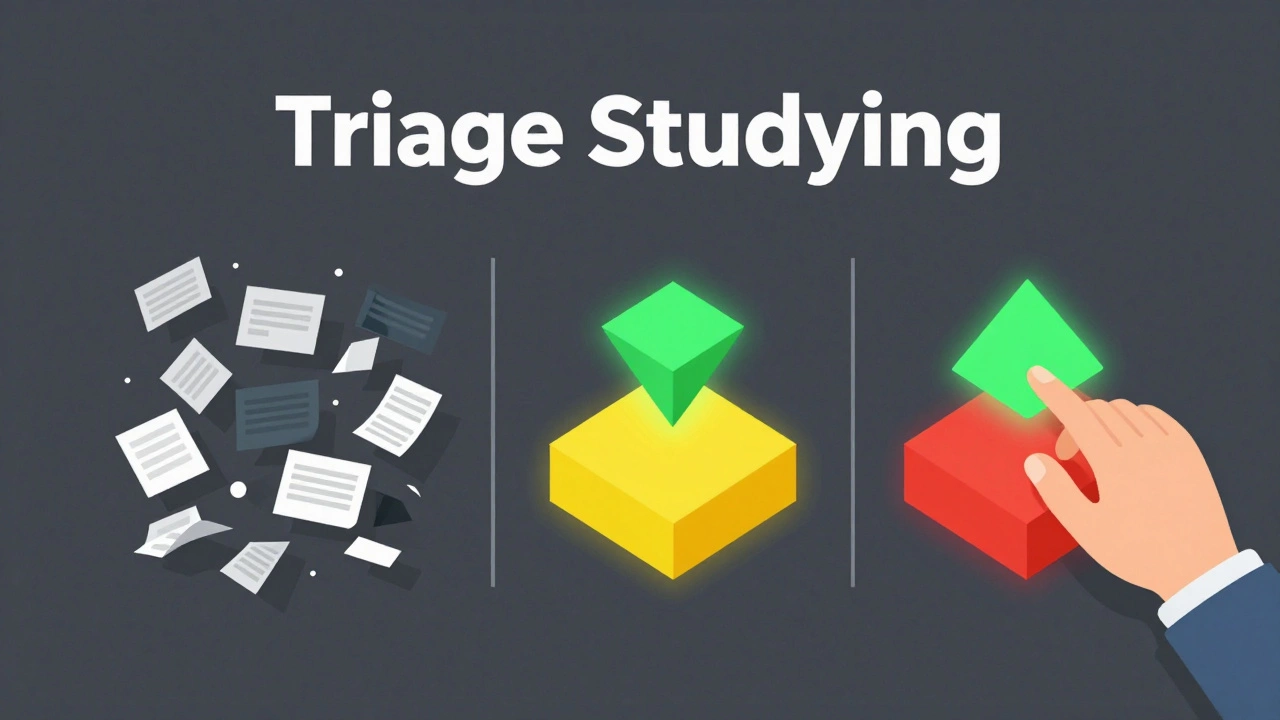
- The Audit (1 hour): Go through your syllabus. Mark topics as 'Green' (I get this), 'Yellow' (I kind of get this), and 'Red' (I have no idea what this is).
- The Pareto Approach: Focus 80% of your energy on the 'Yellow' and 'Red' topics that are most likely to appear. Check old exams or study guides to see which topics carry the most weight.
- Core Concept Mapping: Spend the afternoon building a skeletal outline of the subject. How does Topic A lead to Topic B? If you don't understand the 'why,' the 'what' won't stick.
- The First Pass: Use a timer. Give yourself 45 minutes per major topic. If you hit a wall, move on. You can't afford to get stuck on one difficult equation for three hours.
Day 2: The Application and Refinement Phase
- Past Papers: This is the single most effective way to prepare. Solve at least three years of previous exams. This teaches you the 'language' of the examiner and how questions are phrased.
- Feynman Technique: Pick the hardest concept and try to explain it in simple terms. If you stumble, go back to your notes for five minutes, then try again.
- Gap Filling: Use the afternoon to revisit the 'Red' topics that you just couldn't wrap your head around on Day 1.
- The Final Review: Spend the last two hours before bed reviewing a summary sheet of formulas, dates, or key terms. Your brain processes this information during sleep.
High-Impact Study Techniques for Fast Results
When time is short, efficiency is everything. You need to swap slow methods for fast ones. Forget rewriting your notes in different colored ink-that's just procrastinating with a pen. Instead, focus on these heavy hitters:
| Method | How it Works | Why it Wins for 2-Day Prep |
|---|---|---|
| Spaced Repetition | Reviewing info at increasing intervals | Prevents forgetting Day 1 material by Day 2 |
| Blurting | Writing everything you know on a blank page, then checking what's missing | Instantly highlights knowledge gaps |
| Pomodoro Technique | 25 mins work / 5 mins break | Prevents burnout and maintains high focus |
| Practice Testing | Taking mock exams under timed conditions | Builds stamina and reduces exam anxiety |
Common Pitfalls That Will Kill Your Grade
The biggest mistake students make in a two-day crunch is sacrificing sleep. You might think an all-nighter is the move, but Sleep Deprivation essentially turns your brain into mush. Memory consolidation happens during REM sleep. If you don't sleep, you're essentially pouring water into a bucket with a hole in the bottom. Aim for at least 6 hours. You'll be much better off arriving at the exam with a sharp mind and 80% of the material known than arriving with a zombie brain and 100% of the material 'read'.
Another trap is the 'Resource Spiral.' This happens when you find five different YouTube channels, three different textbooks, and a dozen Reddit threads all explaining the same topic. Pick one reliable source-like your professor's lecture slides-and stick to it. Switching sources wastes precious minutes and creates confusion when different authors use different terminology.

Managing Your Mental State
Panicking is a time-sink. When you spend an hour worrying about how much you've failed, that's an hour you didn't spend studying. Use a 'brain dump' technique. Spend two minutes writing down every fear you have about the exam, then crumble the paper and throw it away. This clears your mental RAM so you can focus on the actual content.
Remember that a exam preparation strategy for two days is about damage control. If you find a topic that is simply too complex to grasp in a few hours, let it go. It is better to be 100% sure of 70% of the material than to be 30% sure of 100% of the material. Guessing on one hard question is a small price to pay for nailing the five easier ones you actually took the time to learn.
Can I actually learn a new subject in 2 days?
Learning a subject from zero to mastery is impossible in 48 hours. However, you can learn the "skeleton" of the subject-the core principles, the most common formulas, and the general logic. This is often enough to pass a basic exam or scrape a decent grade if you are good at applying logic to the questions.
Should I stay up all night before the exam?
No. Sleep is when your brain converts short-term memories into long-term ones. Without sleep, you'll experience "brain fog," making it harder to recall the very things you spent 20 hours studying. A short, focused review session and a full night's sleep will always beat a midnight oil marathon.
What is the fastest way to memorize a list of facts?
Use Mnemonics or Acronyms. Create a silly sentence where the first letter of each word represents a fact you need to remember. The weirder the sentence, the more likely it is to stick. Pair this with a few rounds of active recall (testing yourself) for the best results.
How do I handle a panic attack during study?
Use the 5-4-3-2-1 grounding technique: name 5 things you see, 4 things you can touch, 3 things you hear, 2 things you can smell, and 1 thing you can taste. This pulls you out of your head and back into the present moment so you can restart your timer and get back to work.
Which is better: reading the textbook or doing practice problems?
In a 2-day crunch, practice problems win every time. Reading is passive; solving is active. Practice problems show you exactly what the exam expects and where your knowledge gaps are, whereas reading the textbook often hides those gaps behind a feeling of familiarity.
Next Steps for Different Scenarios
If you're a total beginner: Stop trying to understand the "beauty" of the subject. Focus exclusively on the most common questions from past papers. Memorize the patterns of the answers. Your goal is a pass, not a gold medal.
If you've attended classes but didn't study: You have a foundation. Don't waste time re-reading everything. Go straight to the practice tests. When you get a question wrong, go back to the specific page in the textbook to fix that one gap. This is called "reverse learning" and it's incredibly fast.
If the exam is open-book: Your study time shouldn't be spent memorizing. Instead, spend these two days creating a "super-index." Organize your notes with clear tabs, a comprehensive table of contents, and a cheat sheet of common formulas so you don't waste time hunting for pages during the test.
Write a comment