

ADHD School Support Assessment Tool
Does your child need specialized instruction?
Select the statements that apply to your child's current school experience.
You just got the diagnosis. Your child has ADHD, which stands for Attention-Deficit/Hyperactivity Disorder, a neurodevelopmental condition that affects attention, impulse control, and activity levels. The doctor hands you the paperwork, and suddenly you are standing in front of a school administrator who asks a question that feels like a trap: "Do you want a 504 plan or an Individualized Education Program (IEP)?" If you are not already confused by the medical jargon, this legal distinction might make your head spin. You are not alone. Most parents feel lost here because both plans offer help, but they come from different laws and provide very different types of support.
The short answer is that ADHD can qualify for either a 504 Plan, created under Section 504 of the Rehabilitation Act of 1973, a civil rights law prohibiting discrimination against individuals with disabilities in programs receiving federal funding or an IEP, established under the Individuals with Disabilities Education Act (IDEA), a federal law ensuring free appropriate public education for children with specific disabilities. The choice depends entirely on how much your child’s ADHD impacts their ability to learn and access the general curriculum. Let’s break down exactly what each plan does, who qualifies, and how to decide which one is right for your family.
Understanding the Legal Foundation: Civil Rights vs. Special Education Law
To understand the difference, you first need to look at where these plans come from. They are not just different forms; they are rooted in two separate pieces of legislation with different goals. A 504 Plan comes from Section 504 of the Rehabilitation Act of 1973. This is a civil rights law. Its main job is to ensure that students with disabilities have equal access to education. It says that if a student has a disability that substantially limits a major life activity-like learning, concentrating, or walking-the school must remove barriers so the student can participate alongside their peers. Think of it as leveling the playing field.
An IEP, on the other hand, comes from the Individuals with Disabilities Education Act (IDEA). This is an education law. Its goal is not just access, but benefit. IDEA requires schools to provide specialized instruction and related services designed to meet the unique needs of the child. Under IDEA, there are thirteen specific disability categories. ADHD falls under the category of "Other Health Impairment" (OHI) only if it results in limited alertness with respect to the educational environment, even higher energy levels, or hyperactivity, and adversely affects educational performance. This is a higher bar than the 504 standard.
| Feature | 504 Plan | IEP |
|---|---|---|
| Legal Basis | Section 504 of the Rehabilitation Act (Civil Rights) | Individuals with Disabilities Education Act (IDEA) |
| Goal | Equal access to general education | Specialized instruction to achieve progress |
| Qualification | Disability substantially limits a major life activity | Fits one of 13 IDEA categories AND needs special education |
| Services Provided | Accommodations (changes how student learns) | Modifications & Specialized Instruction (changes what student learns) |
| Team Composition | Parent, teacher, administrator (flexible) | Mandatory team including special ed teacher, psychologist, etc. |
| Review Frequency | At least annually (less formal) | Every 12 months (strict procedural safeguards) |
| Placement Options | General classroom with supports | Least Restrictive Environment (LRE), may include special ed classes |
What Does a 504 Plan Actually Do?
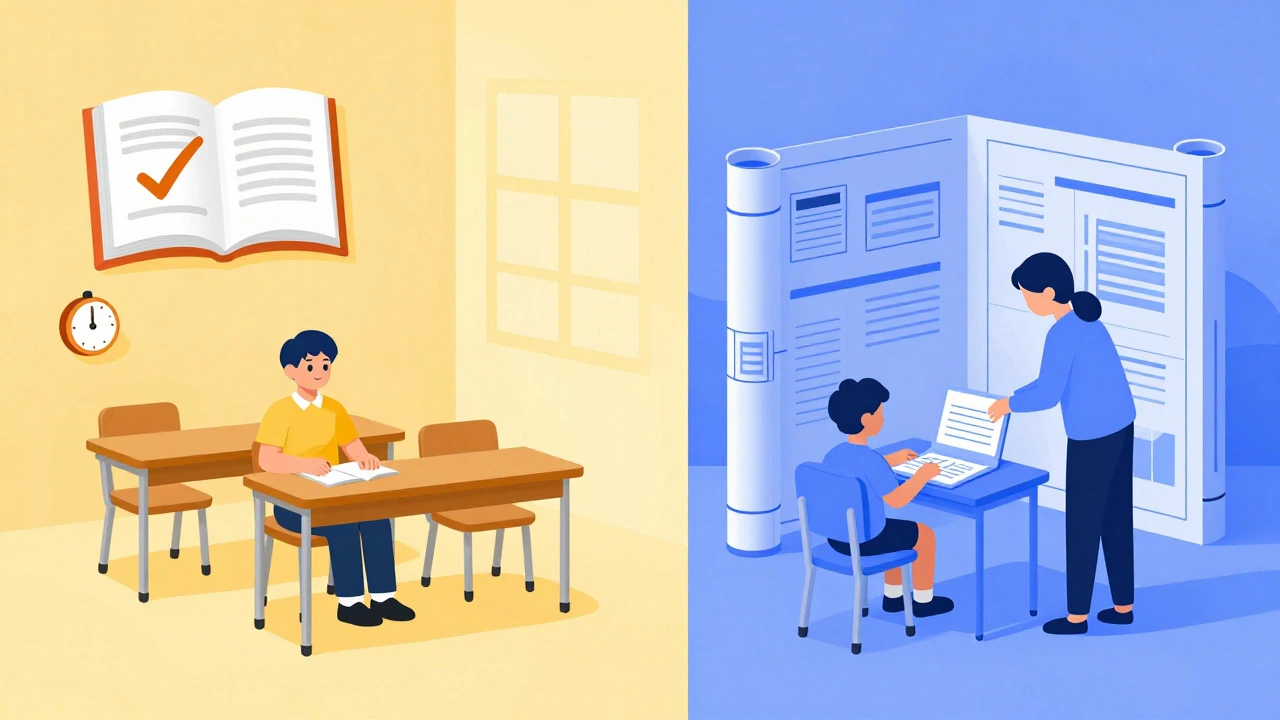
A 504 Plan is essentially a contract between the school and the family that outlines accommodations. Accommodations do not change what the student is expected to learn; they change how the student accesses that information or demonstrates their knowledge. For a student with ADHD, this might mean sitting near the front of the class to minimize distractions, having extended time on tests, or being allowed to take breaks to move around. These changes help the student keep up with the general curriculum without altering the content itself.
The process for creating a 504 Plan is generally less formal than an IEP. The team usually consists of the parent, a general education teacher, and a school administrator or counselor. There is no requirement for a special education teacher or a school psychologist to be present, though they can attend if invited. The evaluation data used to create the plan can come from various sources: report cards, teacher observations, medical diagnoses, and past interventions. The school is not required to pay for an independent evaluation unless they suspect a disability and need more data, but they cannot ignore outside evaluations.
One major advantage of a 504 Plan is flexibility. Because it is not bound by the strict procedural timelines of IDEA, changes can often be made more quickly if the student’s needs shift. However, the downside is that enforcement relies heavily on the goodwill of the staff. If a teacher forgets to give extra time on a test, the recourse is less defined than it is under an IEP. There are fewer procedural safeguards, meaning it can be harder to appeal decisions if you disagree with the school.
When Is an IEP Necessary?
An IEP is a much more robust document. It is a legally binding plan that details specific educational goals, the specialized instruction needed to reach them, and the related services required. If your child’s ADHD is so severe that accommodations alone are not enough, and they need to be taught differently, they likely need an IEP. For example, if a student cannot read at grade level despite years of general education instruction, they might need explicit phonics instruction provided by a special education teacher. That is a modification and specialized instruction, which only an IEP provides.
The IEP team is mandatory and includes specific roles: the parents, at least one general education teacher, at least one special education teacher, a representative of the school district who is qualified to provide or supervise specially designed instruction, someone who can interpret evaluation results (often a school psychologist), and the student (if appropriate). This team meets regularly to review progress. The IEP must include measurable annual goals. Progress toward these goals is reported to parents on report cards. This creates a paper trail of accountability that a 504 Plan lacks.
Under IDEA, the school is responsible for providing a Free Appropriate Public Education (FAPE). This means the education must be tailored to the child’s unique needs and prepared in a Least Restrictive Environment (LRE). LRE means that whenever possible, the student should be educated with non-disabled peers. However, if the student needs significant support, they might spend part of their day in a resource room or a self-contained classroom. A 504 Plan almost always keeps the student in the general education classroom full-time.
Key Differences in Evaluations and Eligibility
Eligibility is the biggest hurdle. For a 504 Plan, the definition of disability is broad. If ADHD substantially limits the major life activity of learning, concentrating, or thinking, the student qualifies. The school can use existing data to make this determination. They do not necessarily need to conduct a comprehensive psychological evaluation, although many do to gather baseline data.
For an IEP, the eligibility criteria are stricter. First, the student must fit into one of the 13 disability categories under IDEA. ADHD is typically classified under "Other Health Impairment." Second, and crucially, the disability must adversely affect educational performance. Third, the student must require special education and related services. Many students with ADHD have average or above-average intelligence and perform well academically when given accommodations. These students often do not qualify for an IEP because they do not need specialized instruction, only access adjustments. If the school believes a student does not need special education, they will likely recommend a 504 Plan instead.
Evaluations for an IEP are comprehensive and paid for by the school district. They must assess all areas related to the suspected disability, including health, vision, hearing, social and emotional status, general intelligence, academic performance, communicative status, and motor development. Parents have the right to disagree with the school’s evaluation and request an Independent Educational Evaluation (IEE) at public expense if they believe the school’s assessment was inadequate.

How to Decide Which Path to Take
So, how do you choose? Start by looking at your child’s current struggles. Are they failing classes because they don’t understand the material, or are they failing because they lose their homework, forget to turn in assignments, or get distracted during tests? If the issue is primarily behavioral or organizational, and the student understands the content when taught correctly, a 504 Plan might be sufficient. If the student is falling behind in core academics despite understanding the concepts, and needs re-teaching or a different instructional method, lean toward an IEP.
Consider the level of support your child needs. Do they need a quiet place to take tests and a visual schedule? Those are accommodations. Do they need small-group reading intervention three times a week? That is specialized instruction. Keep in mind that you can start with a 504 Plan. If the accommodations prove insufficient after a semester or a year, you can request an IEP evaluation. It is often easier to upgrade from a 504 to an IEP than to downgrade from an IEP to a 504, as the latter involves de-certifying a student from special education services.
Also, think about the transition to high school and beyond. An IEP can include transition planning starting at age 14 (or younger in some states), focusing on post-secondary goals like college, vocational training, or independent living. A 504 Plan ends when the student graduates high school or ages out of the system. While a 504 Plan is useful for college accommodations, colleges are not required to provide the same level of proactive support as K-12 schools under IDEA. Having an IEP history can sometimes provide stronger documentation for college disability services offices, though the 504 Plan itself is often the direct tool used in higher education.
Navigating the Process: Tips for Parents
Regardless of which path you choose, preparation is key. Document everything. Keep a folder of report cards, teacher emails, medical records, and notes from meetings. When you request an evaluation, do it in writing. Email is fine, but certified mail provides proof of delivery. State clearly that you are requesting an evaluation for a 504 Plan or an IEP due to suspected disability.
Bring an advocate or a trusted friend to meetings. Taking notes while listening to complex legal discussions is difficult. Having a second set of eyes ensures you don’t miss important details. Ask questions if something is unclear. Terms like "related services," "manifestation determination," and "procedural safeguards" have specific legal meanings. Don’t be afraid to ask the school to explain them in plain English.
Remember that collaboration works better than confrontation. Schools are often overwhelmed and understaffed. Approaching the team as partners working toward your child’s success can yield better results than assuming the worst intentions. However, know your rights. If the school denies your request for an evaluation, ask for the denial in writing with the reasons why. This creates a record that can be used in mediation or due process hearings if necessary.
Can a student have both a 504 Plan and an IEP?
Technically, yes, but it is redundant. An IEP supersedes a 504 Plan. If a student qualifies for an IEP, the IEP should include all necessary accommodations. Having both documents can create confusion about which plan governs the student’s services. Most schools will consolidate the supports into the IEP.
Does ADHD automatically qualify for an IEP?
No. A diagnosis of ADHD is not enough. The student must meet the criteria for "Other Health Impairment" under IDEA and demonstrate a need for specialized instruction. Many students with ADHD only need accommodations, making them eligible for a 504 Plan instead.
How long does it take to get a 504 Plan or IEP?
Timelines vary by state and district. For an IEP, IDEA sets strict deadlines for evaluations (often 60 days from consent) and initial meetings. 504 Plans have no federal timeline, but most districts aim to complete the process within 30-45 days. Check your local district policies for specific dates.
Can a private school student get a 504 Plan or IEP?
Private schools that receive any federal funding must comply with Section 504, so they can offer 504 Plans. However, IDEA (IEPs) applies primarily to public schools. Private school students may be eligible for services through their local public school district, but the public school is not required to provide a full FAPE if the parents chose the private placement voluntarily.
What happens if the school refuses to evaluate my child?
If the school refuses, they must provide prior written notice explaining the refusal. You can then request mediation, file a state complaint, or initiate a due process hearing. It is helpful to have outside evaluations and documentation ready to support your case.
Do 504 Plans expire?
504 Plans should be reviewed at least once a year. They remain in effect until the student graduates, ages out, or the team determines the disability no longer substantially limits a major life activity. Unlike IEPs, which end at graduation or age 21/22 depending on the state, 504 protections extend through college if the student registers with the disability services office.
Write a comment