

Fast-Track Degree Time & Cost Estimator
Enter your current academic status to see estimated time-to-degree and potential tuition savings based on different educational models.
Fill in the form to get your personalized fast-track plan.
Key Acceleration Tactics
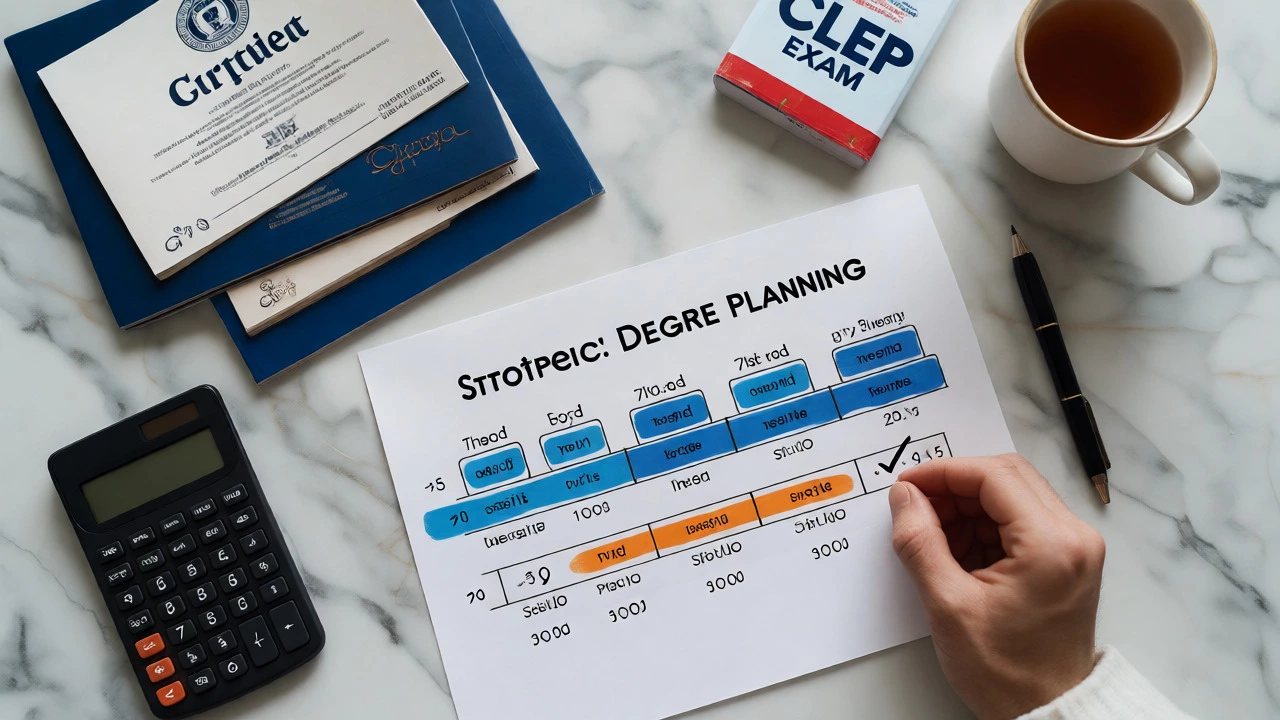
- Credit for Prior Learning: Use CLEP/DSST exams to waive general ed requirements ($90 vs $1,000+ per course).
- Competency-Based Education (CBE): Schools like WGU allow you to test out of courses immediately upon mastery.
- Continuous Enrollment: Online programs often lack breaks, allowing back-to-back terms.
You want a degree. You need it for that promotion, the visa application, or just to prove you can finish what you start. But sitting in a lecture hall for four years feels like an eternity when you have bills to pay and life moving fast. The good news? You don't always need four years. In fact, some students graduate with a bachelor's degree in as little as 12 to 18 months. How? By hacking the system with prior learning credits, choosing accelerated formats, and picking majors that don't require clinical hours.
But "quickest" isn't just about speed. It's about efficiency. If you pick a program that takes six months but costs double, is it really faster? Probably not. Let's break down exactly which degrees are the fastest to complete, how to shave time off your timeline, and which traps to avoid so you don't end up with a piece of paper nobody respects.
The Shortest Path: Associate Degrees vs. Bachelor's
Before we talk about bachelor's degrees, let's look at the lower rung. An Associate Degree is a two-year undergraduate academic degree awarded by community colleges, junior colleges, technical colleges, and some universities. For many people, this is the actual quickest credential you can get that carries weight. It’s perfect if you want to enter the workforce quickly in fields like nursing (ADN), paralegal studies, or IT support.
However, most job postings still ask for a bachelor's. So, if you're aiming for corporate roles, management, or specialized tech jobs, you likely need the four-year equivalent. The trick is finding where those four years compress into one or two.
Competency-Based Education: The Game Changer
If you already have work experience, traditional courses might be wasting your time. Enter Competency-Based Education (CBE), also known as self-paced learning, is an educational approach that focuses on demonstrating mastery of specific skills rather than spending a set amount of time in class.
Schools like Western Governors University (WGU) and Capella University use this model. Here’s how it works: You don't sit through lectures. You study until you know the material, then take a test. Pass the test? Move on. Fail? Try again. There is no semester clock ticking down. If you are disciplined and already know half the material from your job, you could theoretically finish a Bachelor of Science in Information Technology in under a year. I’ve seen students finish in eight months because they treated studying like a full-time job.
| Learning Model | Typical Duration | Best For | Key Constraint |
|---|---|---|---|
| Traditional On-Campus | 4 Years | Fresh high school grads | Fixed schedule; slow pace |
| Accelerated Online | 2-3 Years | Working adults | Requires heavy course load per term |
| Competency-Based (CBE) | 6 Months - 2 Years | Experienced professionals | Requires high self-discipline |
| Degree Completion Program | 1 Year | Those with existing credits | Must transfer credits successfully |
Majors That Finish Fastest
Not all degrees are created equal when it comes to time. Why? Because some require labs, internships, or clinical rotations. You can’t rush a nursing student through their hospital shifts. But you can rush someone through Business Administration or Computer Science theory.
- Business Administration: This is often the fastest bachelor's degree available online. Many programs allow you to transfer up to 90 credits. If you have an associate degree or work experience, you might only need 30 credits left. That’s roughly one year of full-time study.
- Criminal Justice: Similar to business, this major relies heavily on reading and writing. No labs. No clinicals. Many online schools offer accelerated terms here.
- Computer Information Systems: While coding takes practice, many entry-level CIS degrees focus on management and theory. If you’re already a developer, you can test out of introductory programming classes.
- Psychology (BA): Note the BA (Bachelor of Arts). A BS in Psychology often requires lab hours and research projects. A BA is more flexible and can often be completed faster via online modules.

Hacking Your Timeline: Credit for Prior Learning
The biggest accelerator isn't the school; it's your history. Most accredited universities will grant credit for things you've already done. This is called Credit for Prior Learning (CPL), which includes Advanced Placement (AP) exams, College Level Examination Program (CLEP), DSST, and industry certifications.
Here is a real-world example: Sarah worked in HR for five years. She took CLEP exams for English Composition and Introductory Sociology. She passed them over a weekend. Those tests gave her 12 credits-equivalent to two full college classes-for about $100 total. Compare that to paying $3,000 per class at a university. Multiply that savings across ten exams, and she saved thousands of dollars and two semesters of time.
Action Step: Before enrolling anywhere, ask the admissions office: "Do you accept CLEP or DSST exams?" If they say no, walk away. You need a school that values your existing knowledge.
Online vs. Traditional: Where Speed Happens
You cannot get a quick degree in a traditional setting unless you overload your schedule. And even then, you are bound by the semester calendar. If you miss a registration window, you wait three months. In an online degree, you control the pace. Many online programs run continuously. You can start a new class the day after you finish the last one. There are no winter breaks, no summer slumps.
This continuous enrollment model is why online degrees dominate the "fastest degree" conversation. According to data from the National Center for Education Statistics, adult learners who attend fully online institutions complete degrees at higher rates than those attending traditional brick-and-mortar schools part-time. Why? Because they don't drop out due to scheduling conflicts.
The Hidden Costs of Going Too Fast
Speed has a price. If you try to do too much at once, you risk burnout or poor grades. Some employers care less about how fast you finished and more about your GPA. If you rush through a degree and barely pass, you might hurt your chances for grad school or competitive jobs.
Also, beware of "diploma mills." These are unaccredited schools that promise a degree in weeks for a flat fee. They exist. Avoid them. Employers check accreditation. Stick to regionally accredited institutions. In the US, look for accreditation from bodies like the Higher Learning Commission (HLC) or the Southern Association of Colleges and Schools (SACS). In New Zealand, ensure the provider is registered with NZQA.
Step-by-Step Plan to Graduate Fast
Ready to start? Here is your checklist to minimize time-to-degree:
- Inventory Your Credits: Gather transcripts from any previous college attendance. Check if you have an associate degree. If yes, you are halfway there.
- Test Out: Register for CLEP or DSST exams for general education requirements (Math, English, History). Study for two weeks per exam. Pass them.
- Choose a Competency-Based School: Look for WGU, Thomas Edison State University, or Excelsior University. These schools specialize in rapid completion for adults.
- Transfer Aggressively: Don't take a class if you can test out of it. Don't take a prerequisite if you have professional certification that covers it.
- Treat It Like a Job: Dedicate 20-40 hours a week to studying. Consistency beats intensity. Studying 2 hours every night is better than cramming 15 hours on Sunday.
Is a Fast Degree Worth It?
Absolutely, if done correctly. A degree is a signal. It tells employers you can handle complex information and meet deadlines. Whether it took you two years or four matters less than the fact that you hold the credential. However, pair the speed with substance. Use the time you save to gain work experience. A person with a 2-year accelerated degree and 3 years of relevant work experience is often more hireable than someone with a 4-year degree and zero experience.
Remember, the goal isn't just to finish. It's to advance. Pick the path that gets you to the next step in your career without burning bridges or breaking the bank.
Can I really get a bachelor's degree in one year?
Yes, but usually only if you already have significant transfer credits. If you start from scratch, one year is extremely difficult even in accelerated programs. Most "one-year" claims assume you are finishing a degree you started elsewhere or using extensive credit-for-experience policies.
Are online degrees respected by employers?
Generally, yes. As long as the institution is regionally accredited, employers treat online degrees the same as on-campus ones. The stigma around online learning has largely disappeared since the rise of remote work. Focus on the reputation of the school, not the delivery method.
What is the easiest major to finish quickly?
Business Administration and General Studies are typically the fastest. They have broad elective options, allowing you to use diverse transfer credits. Avoid majors requiring licensure (like Nursing or Teaching) if speed is your primary goal, as clinical hours cannot be rushed.
How much does CLEP testing cost compared to tuition?
A CLEP exam costs approximately $90 plus a small administrative fee charged by the testing center. In contrast, a single 3-credit college course can cost between $1,000 and $3,000 depending on the institution. Passing CLEP exams can save thousands of dollars and months of time.
Do I need to go to school full-time to graduate fast?
In competency-based models, "full-time" status is defined by progress, not hours spent. You can technically enroll part-time but move at a full-time pace. In traditional models, taking fewer than 12 credits per semester will extend your graduation date significantly.
Write a comment