
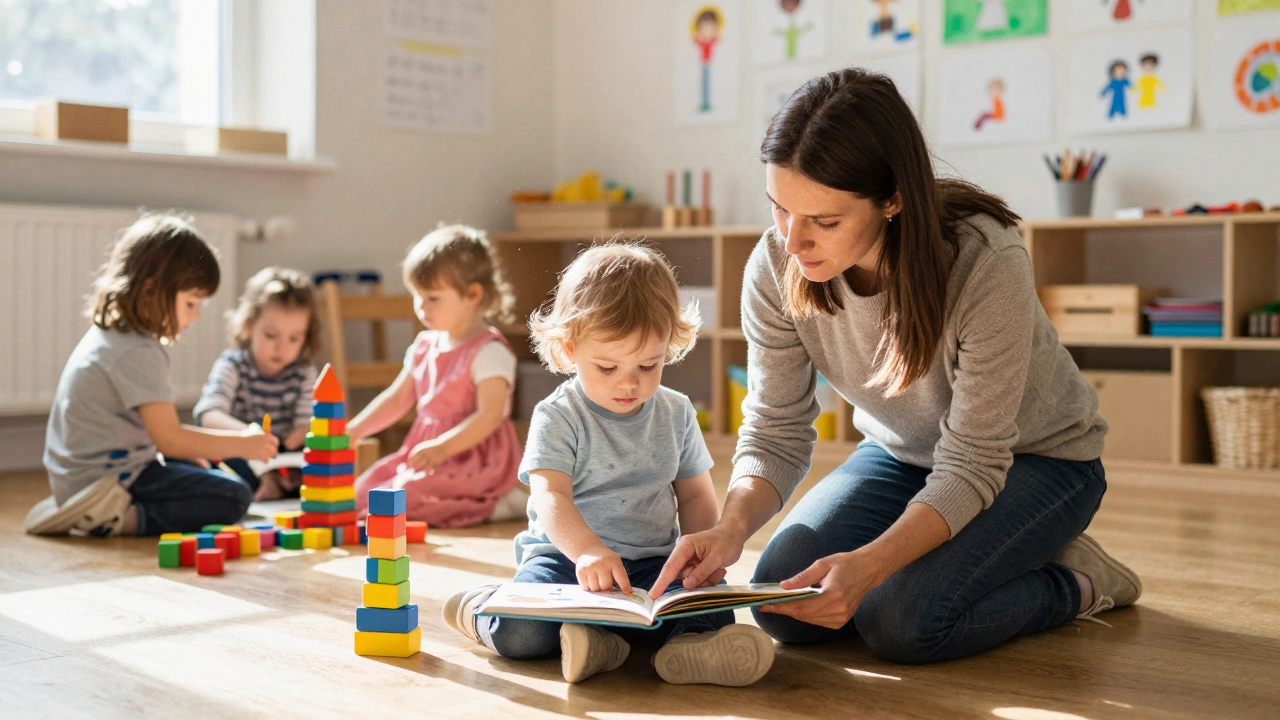
Early childhood educators don’t just watch kids play. They’re the ones who notice when a toddler stops speaking in full sentences, when a four-year-old struggles to share a toy, or when a child who used to run to the playground now hangs back at the door. These aren’t small moments-they’re clues. And early childhood educators are trained to read them, respond to them, and turn them into learning opportunities.
They Build the Foundation for Lifelong Learning
The brain develops faster between birth and age five than at any other time in life. By age three, a child has formed about 80% of their brain’s structure. An early childhood educator doesn’t teach ABCs and 123s in the way you might think. Instead, they create environments where language grows through songs and stories, math emerges from sorting blocks by size, and social skills are practiced during pretend tea parties. These aren’t distractions from learning-they’re the foundation of it.
Research from the University of Cambridge shows that children who attend high-quality early education programs are 25% more likely to graduate high school and 40% more likely to go to college. That’s not because they memorized more sight words. It’s because their educators helped them learn how to focus, how to ask for help, and how to handle frustration-skills that matter more than knowing the color of the sky by age four.
They’re the First Detectives of Development
Most parents don’t know what a typical speech milestone looks like at age two-and-a-half. They might think their child is just shy. But an early childhood educator sees patterns. They notice if a child doesn’t respond to their name, avoids eye contact, or repeats phrases without understanding them. These aren’t red flags to panic over-they’re signals to act.
Early childhood educators work closely with speech therapists, occupational therapists, and psychologists when needed. They’re often the first to flag potential delays, not because they’re diagnosing, but because they spend 30+ hours a week watching how children interact, move, and communicate. In New Zealand, the Ministry of Education requires all licensed early childhood services to have staff trained in developmental monitoring. That’s not bureaucracy-it’s prevention.
They Create Safe Spaces for Emotional Growth
Imagine a child who wakes up to a house where no one speaks, where meals are rushed, where the parent works two jobs and comes home exhausted. For that child, the early learning center might be the only place where someone sits down, looks them in the eye, and says, ‘Tell me about your day.’
Early childhood educators provide emotional regulation. They help children name feelings-‘I see you’re angry because your tower fell.’ They model calm responses when tempers flare. They teach that it’s okay to cry, to ask for help, to take a breath. These aren’t soft skills. They’re survival skills. Kids who learn to manage big emotions before school are less likely to be expelled from kindergarten, less likely to be labeled ‘problematic,’ and more likely to build healthy relationships later in life.

They’re Not Babysitters-They’re Curriculum Designers
There’s no textbook for teaching a two-year-old how to tie their shoes. Early childhood educators design daily routines that build independence: choosing their own snack, putting on their coat, washing hands before lunch. They plan activities based on what the children show interest in-whether it’s digging in the dirt, stacking cups, or pretending to be dinosaurs.
They use play as a curriculum. A block tower isn’t just fun-it’s physics, engineering, and problem-solving. A pretend grocery store teaches counting, money, social roles, and language. A group painting session develops fine motor skills and cooperation. Every activity is intentional. Every moment is a chance to learn.
In New Zealand, the national early childhood curriculum, Te Whāriki, doesn’t list learning outcomes like ‘child will count to ten.’ Instead, it talks about children becoming ‘confident and competent learners.’ That’s the goal-not checking boxes, but building agency.
They Partner With Families-Not Just Supervise
Early childhood educators don’t wait for parent-teacher meetings. They send home photos of children building with blocks and write notes like, ‘Liam noticed the red block was heavier. He tried three different ways to balance it.’ They ask parents what their child loves at home-maybe it’s singing lullabies in Spanish, or collecting leaves, or watching the same cartoon every night. They use that to make learning feel familiar.
They know that a child who speaks two languages at home isn’t ‘delayed’-they’re bilingual. They don’t try to ‘fix’ cultural differences. They celebrate them. In Wellington, many centers now include Māori language and practices in daily routines-greetings in te reo, storytelling with pūrākau, and karakia before meals. That’s not just inclusion. It’s respect.

They Work in Low-Paid, High-Stakes Jobs
Here’s the truth: early childhood educators in New Zealand earn, on average, $24 an hour. That’s less than many retail workers. Yet they hold degrees in child development, complete hundreds of hours of supervised practice, and pass criminal background checks. They work with children who have complex needs, manage teams of assistants, and stay calm when a child hits, bites, or screams.
They don’t get paid for the extra hours they spend planning lessons, writing reports, or calling parents after work. They don’t get bonuses for the child who finally says ‘mama’ after six months of silence. They do it because they see the change.
And that change? It lasts. A child who learns to trust an educator at age three is more likely to trust a teacher at age seven. A child who learns to ask questions in preschool is more likely to speak up in class at age ten. The role of an early childhood educator isn’t about what happens in the classroom. It’s about what happens in the rest of a child’s life.
They’re the Quiet Architects of Society
When you hear about rising youth mental health rates, school dropout numbers, or unemployment among young adults, the roots often go back to early childhood. The kids who struggled to make friends at four. The ones who never learned to sit still. The ones who never heard a book read aloud at home.
Early childhood educators are the ones who show up every day to give those kids a different start. They don’t get parades. They don’t get headlines. But they’re the reason some children grow up believing they matter-because someone, somewhere, paid attention to them when they were small.
What qualifications do you need to be an early childhood educator?
In New Zealand, you need at least a Level 4 qualification in early childhood education, like a Certificate in Early Childhood Education and Care. Many go on to earn a Diploma (Level 5) or Bachelor’s degree (Level 7). You also need a current police vet, first aid certification, and ongoing professional development. The government funds training through pathways like Te Pūkenga, making it more accessible than ever.
Is early childhood education the same as preschool?
Not exactly. Preschool usually refers to programs for three- to five-year-olds. Early childhood education covers everything from birth to age five-including home-based care, kindergartens, crèches, and play centers. It’s a broader term that includes all formal and informal learning environments for young children. The focus isn’t on age, but on developmental support.
Do early childhood educators teach reading and writing?
They don’t drill phonics like a primary school teacher. Instead, they build the skills that make reading and writing possible. They read aloud daily, point out letters in environmental print (like ‘STOP’ on signs), encourage scribbling and drawing, and help children understand that marks on paper carry meaning. By age five, many children can recognize their name, retell stories, and hold a pencil correctly-not because they were forced to, but because they were surrounded by rich language experiences.
How do early childhood educators handle behavior problems?
They don’t punish. They observe. They ask: ‘What is this behavior telling me?’ A child who hits might be overwhelmed. A child who withdraws might be scared. Educators use strategies like positive redirection, setting clear limits with calm voices, and teaching replacement behaviors-like using words instead of fists. They work with families and specialists to create individualized plans. It’s about understanding, not control.
Why is play so important in early childhood education?
Play is the child’s work. When a child builds a tower, they’re learning balance and cause-and-effect. When they pretend to be a doctor, they’re practicing empathy and language. When they negotiate rules in a game, they’re learning compromise. Play isn’t a break from learning-it’s the main way young children make sense of the world. Educators don’t just allow play-they plan for it, extend it, and document it as learning.
What Happens If We Ignore This Role?
When early childhood education is underfunded, understaffed, or undervalued, the cost shows up later. Kids enter school without the ability to sit still, follow instructions, or share. Teachers spend more time managing behavior than teaching. Parents are overwhelmed, unsure where to turn. The gap between children who had access to quality early learning and those who didn’t grows wider every year.
It’s not about making children ‘ready for school.’ It’s about making sure every child, no matter their background, gets a fair start. And that starts with recognizing early childhood educators for what they are: essential professionals who shape the future, one small moment at a time.
Write a comment