

Ask any group of students, teachers, or even parents which A level is the least respected, and you’ll get a clear, almost automatic answer: General Studies. It’s not just a quiet outlier-it’s the subject that gets laughed at in staff rooms, dismissed by university admissions tutors, and treated like an afterthought by schools themselves.
But why? Is it really that useless? Or is the stigma built on outdated assumptions, misinformation, and a system that values certain skills over others?
Why General Studies Got the Boot
General Studies was designed as a broadening subject-something to give students a taste of politics, philosophy, ethics, current affairs, and basic science. It wasn’t meant to be a deep dive into any one field. That’s exactly why universities started rejecting it.
Starting in the early 2010s, top universities like Oxford, Cambridge, and Imperial College London began explicitly stating they wouldn’t count General Studies toward entry requirements. The reasoning? It didn’t demonstrate the analytical depth, subject-specific knowledge, or academic rigor expected at degree level. By 2018, over 80% of Russell Group universities had either excluded it or treated it as a fourth subject with no weight.
Schools noticed. Many stopped offering it. Others kept it only because it filled a timetable slot or helped students reach the minimum three A levels. But even then, it was often treated as a ‘free’ subject-something to boost the overall grade count without real academic value.
The Other Contenders: What About Psychology or Media Studies?
General Studies isn’t the only subject with a bad reputation. Psychology, Media Studies, and Business Studies often get dragged into the same conversation. But here’s the twist: these subjects aren’t universally dismissed.
Psychology, for example, is now one of the most popular A levels. It’s accepted by medical schools, law programs, and even engineering departments. Why? Because it teaches research methods, statistics, and critical thinking-all skills universities want. It’s not the subject itself that’s the problem. It’s how it’s taught.
Media Studies gets flak because it’s seen as ‘easy’-lots of watching films and writing opinions. But at top schools, students analyze semiotics, media ownership, and cultural theory using academic frameworks. Those who take it seriously get strong grades and go on to study communications, journalism, or sociology at university.
Business Studies? It’s the most misunderstood. Critics say it’s just common sense. But if you’re learning about cash flow forecasting, market segmentation, or corporate governance using real case studies, it’s a serious, quantitative subject. The problem? Many schools teach it as a series of definitions and bullet points. That’s not the subject’s fault-it’s poor delivery.
What Makes a Subject ‘Respected’?
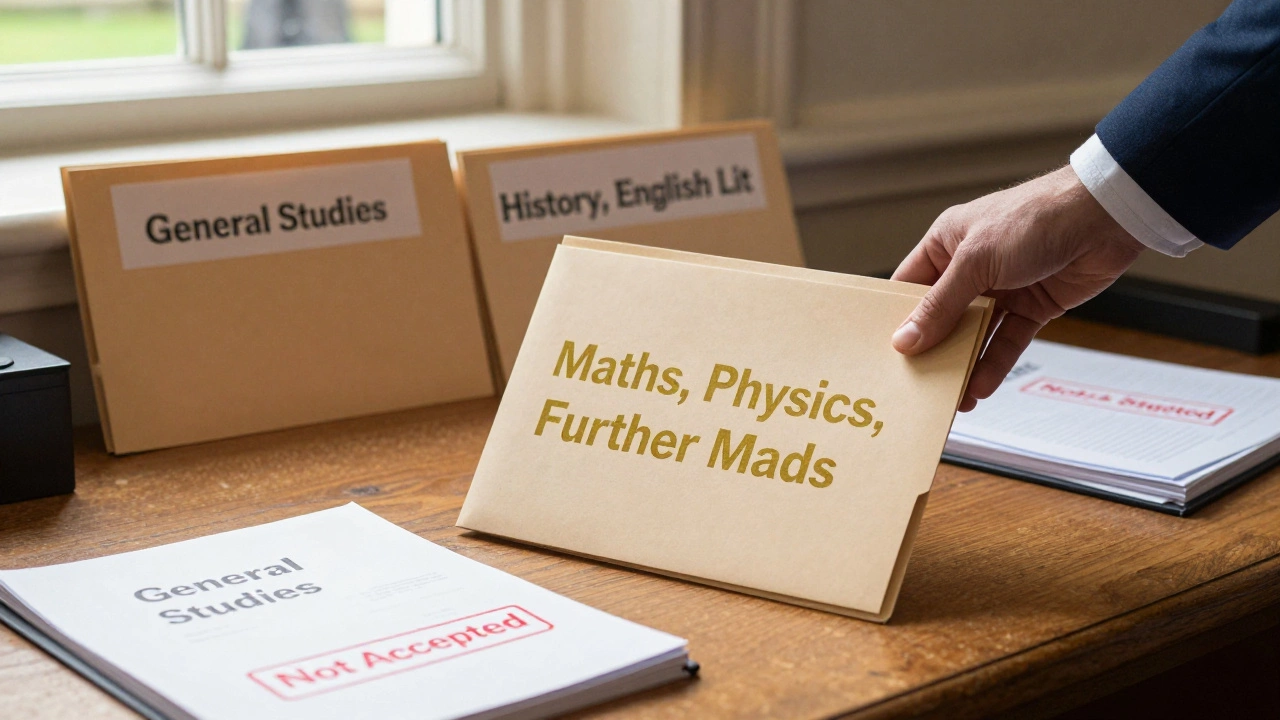
The real issue isn’t the subject. It’s the perception of difficulty and academic weight. Subjects like Mathematics, Physics, Chemistry, and Further Maths are called ‘facilitating subjects’ because they’re gateways to STEM degrees. History, English Literature, and Modern Languages are seen as ‘traditional’ and intellectually demanding.
But here’s what nobody says out loud: respect is tied to gatekeeping. Universities don’t reject subjects because they’re easy. They reject them because they don’t fit the mold they’ve built for decades. A-levels were designed in the 1950s to prepare students for elite universities. The system hasn’t caught up with the fact that modern careers-digital marketing, UX design, data journalism, AI ethics-don’t need a classical science background.
General Studies might not teach you calculus. But it teaches you how to weigh evidence, spot bias, and argue logically across disciplines. Those are skills employers pay for.
The Real Cost of the Stigma
The problem isn’t just about university admissions. It’s about students being told their interests are worthless.
Imagine a student who loves watching documentaries, reads The Guardian daily, and debates politics with their family. They choose General Studies because it lets them explore what they care about. But they’re told by their teacher, ‘You’ll never get into a good uni with this.’
That’s not just discouraging-it’s damaging. It tells students their curiosity isn’t valid unless it fits a narrow, outdated mold.
And the irony? Many students who take General Studies go on to do well in university. A 2023 study by the Higher Education Policy Institute found that students who took General Studies alongside three ‘facilitating’ subjects performed just as well in their first year as those who took four traditional subjects. The subject didn’t hold them back. The stigma did.

What’s Replacing General Studies?
Since 2020, the exam boards have phased out General Studies as a standalone A level. In its place, schools now offer Extended Project Qualifications (EPQ), Critical Thinking, or AS levels in subjects like Citizenship or Sociology.
The EPQ is the real successor. It’s a 5,000-word research project on any topic the student chooses-everything from AI ethics to the history of hip-hop. It’s assessed like a university essay. Top universities love it. It’s harder than General Studies. And it’s respected.
But not every school can support an EPQ. It needs teacher training, time, and resources. So many students are still stuck with weak alternatives-like taking a fourth A level in a subject they hate just to look ‘serious’ on their application.
So Is There a ‘Least Respected’ A Level?
Yes. But not because of the subject itself.
General Studies was the least respected because it didn’t fit the old system. It didn’t have a clear path to a degree. It didn’t look like the subjects on the ‘preferred’ list.
But the truth? There’s no such thing as a ‘worthless’ A level. Only poorly taught ones. And a system that still judges students by the wrong metrics.
Today, the most respected A levels aren’t necessarily the hardest. They’re the ones that show you can think, adapt, and learn independently. If you’re taking Media Studies and analyzing how algorithms shape public opinion? That’s more valuable than memorizing a textbook chapter on Newton’s laws.
Respect isn’t given. It’s earned. And it’s time the system started rewarding the right things.
Is General Studies still available as an A level?
No. General Studies was officially phased out by all major exam boards in 2020. It’s no longer offered as a standalone A level. Schools now encourage students to take the Extended Project Qualification (EPQ) instead, which is more rigorous and better regarded by universities.
Do universities still look down on subjects like Psychology or Media Studies?
Not if they’re taken seriously. Top universities accept Psychology and Media Studies for relevant degrees-psychology for psychology courses, media studies for communications or journalism. The issue isn’t the subject, it’s how it’s taught. If you’re doing data analysis, critical theory, or independent research, it’s respected. If you’re just watching films and writing summaries, it won’t stand out.
Should I avoid taking ‘non-traditional’ A levels?
No-but don’t take them as a backup. Choose subjects you’re genuinely interested in and that align with your future goals. If you want to study sociology, take Psychology or Sociology. If you’re aiming for design or media, take Media Studies. Universities care more about your grades, your motivation, and what you’ve learned than the name on the certificate.
What’s the difference between General Studies and the EPQ?
General Studies was a broad, exam-based course covering random topics like ethics or current events. The EPQ is a self-directed research project. You pick a topic, write a 5,000-word essay, and present your findings. It’s assessed like a university assignment and is worth half an A level. Universities prefer the EPQ because it shows independence and critical thinking.
Are A levels still the best path to university?
For most UK students, yes. But they’re not the only path. BTECs, International Baccalaureate, and foundation years are gaining ground, especially for vocational or creative fields. What matters most is whether your qualifications show you’re ready for university-level work-not whether they fit a 1980s checklist.
Write a comment