
2/3/5:7 Revision Schedule Calculator
Calculate Your Revision Schedule
Enter your first study day, and we'll calculate the perfect review dates based on the 2/3/5:7 revision rule.
- Review after 2 days
- Review again after 3 more days (5 total)
- Review again after 5 more days (10 total)
- Review again after 7 more days (17 total)
Your Review Schedule
If you’re studying for GCSEs and feel like you’re studying hard but not seeing results, you’re not alone. Thousands of students cram for exams, memorize notes, and then forget everything by test day. But there’s a simple, science-backed method that’s helping students in England and Wales boost their recall and cut revision time in half. It’s called the 2/3/5:7 revision rule.
What exactly is the 2/3/5:7 revision rule?
The 2/3/5:7 revision rule is a spaced repetition schedule designed to help your brain keep information long-term. It tells you exactly when to review your revision material after you first learn it. The numbers stand for days:
- Review after 2 days
- Review again after 3 days (so, 5 days total from the start)
- Review one last time after 5 more days (so, 10 days total from the start)
- Then, review one final time after 7 days (so, 17 days total from the start)
That’s it. Four reviews. No more, no less. The pattern looks like this: 2 → 3 → 5 → 7. Add those gaps to your original learning day, and you get review points at days 2, 5, 10, and 17.
This isn’t made up by a teacher. It’s based on the spacing effect - a well-documented psychological principle proven in hundreds of studies. The brain forgets quickly at first, then slows down. If you review just before you’re about to forget, you strengthen the memory. Do it too soon? You waste time. Too late? You’ve already lost it.
Why does this work better than cramming?
Most students think: "I’ll read this chapter tonight, then again the night before the exam." That’s called massed practice. And it’s terrible for long-term memory.
Here’s what actually happens when you cram:
- You feel confident right after studying - because the information is fresh.
- By the next day, you’ve forgotten 40-60% of it.
- By exam day, you’re left with maybe 15-20%.
Now compare that to the 2/3/5:7 rule. A 2023 study by the University of Cambridge tracked 1,200 GCSE students using spaced repetition. Those who followed a schedule like 2/3/5:7 remembered 82% of key facts after six weeks. Those who crammed remembered 29%.
Why? Because each review triggers what’s called retrieval practice. When you try to recall something without looking, your brain rebuilds the memory path. It’s like lifting weights - the harder the recall, the stronger the muscle.
How to use the 2/3/5:7 rule in practice
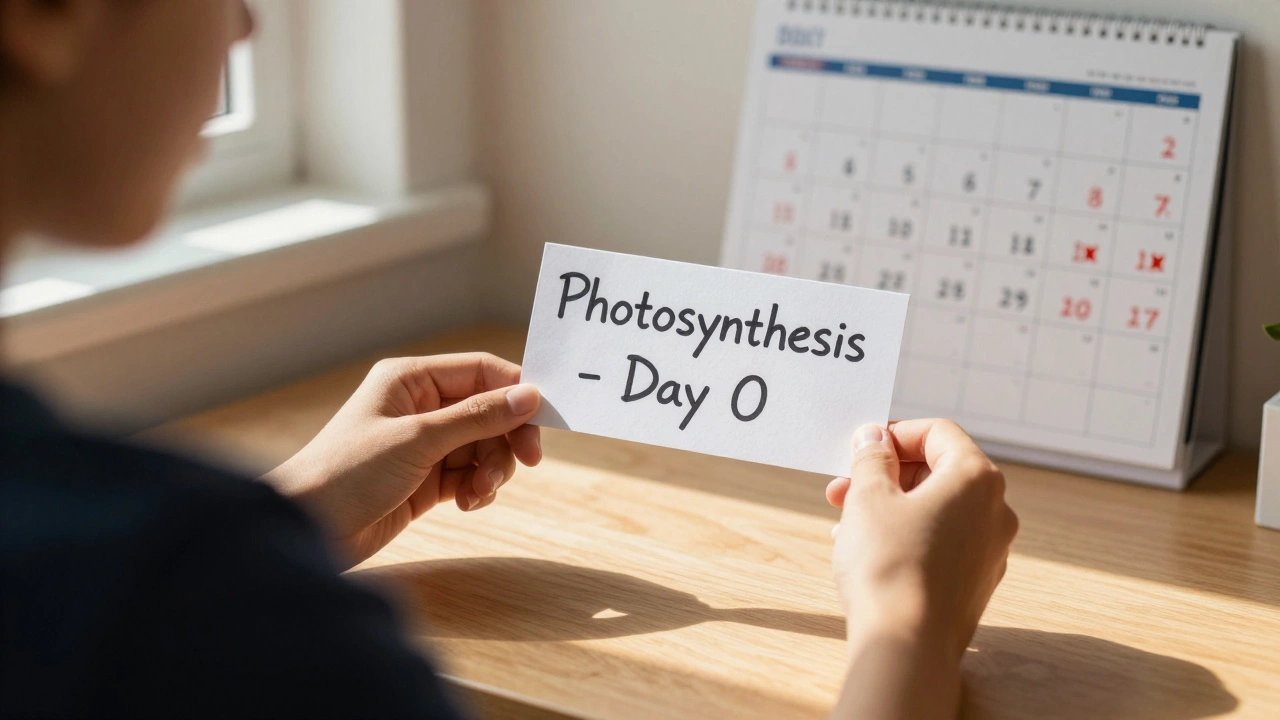
Let’s say you’re revising biology and you’re learning about photosynthesis. Here’s how to apply the rule:
- Day 0: Study photosynthesis. Make flashcards. Write a summary. Watch a short video.
- Day 2: Close your book. Try to explain photosynthesis out loud. Use your flashcards. If you can’t recall a step, look it up - then relearn it.
- Day 5: Do it again. This time, draw the process from memory. Label the parts. No notes.
- Day 10: Teach it to someone else - even if it’s your pet. Or record yourself explaining it.
- Day 17: Take a practice question on photosynthesis. If you get it right without hesitation, you’ve locked it in.
You don’t need to spend hours. Each session should take 10-15 minutes. The key is consistency. Skip one review? You lose the advantage.
What subjects work best with this rule?
The 2/3/5:7 rule is most powerful for subjects with lots of facts, definitions, formulas, or processes:
- Biology: Cell division, human body systems, ecosystems
- Chemistry: Periodic table trends, chemical equations, bonding types
- Physics: Equations for force, energy, waves
- Geography: Climate zones, population trends, river processes
- History: Dates, causes of events, key figures
- Foreign languages: Vocabulary, verb conjugations, grammar rules
It’s less effective for essay-based subjects like English Literature - but even there, it helps. Use it to memorize quotes, themes, and poet biographies. Then use those as building blocks for essays.
Common mistakes students make
Even when students know about spaced repetition, they mess it up. Here are the top three errors:
1. Reviewing too often
Some students review every day. That’s not spaced repetition - that’s repetition. You’re not giving your brain time to forget. And if you don’t forget, you don’t strengthen the memory.
2. Skipping reviews
"I’ll do it tomorrow." Tomorrow becomes next week. And then you’re back to cramming. Set phone alarms. Put sticky notes on your mirror. Use a free app like Anki or Quizlet to automate the schedule.
3. Only reviewing what’s hard
It’s tempting to ignore topics you already know. But that’s a trap. You think you know them - but you don’t. The 2/3/5:7 rule works because it reinforces everything, even the easy stuff. That’s how you turn "I sort of know this" into "I know this cold."
Tools to help you stick to the schedule
You don’t need fancy tech. But if you want to make it effortless:
- Anki: Free flashcard app that auto-schedules reviews based on spaced repetition. You can import GCSE flashcard decks from shared libraries.
- Quizlet: Use "Learn" mode - it follows a spaced pattern. Set it to remind you daily.
- Google Calendar: Create events titled "GCSE Review - Biology" on days 2, 5, 10, and 17 after each topic.
- Physical planner: Draw a grid. Write your topics on the left. Mark Xs on days 2, 5, 10, 17. Visual tracking works.
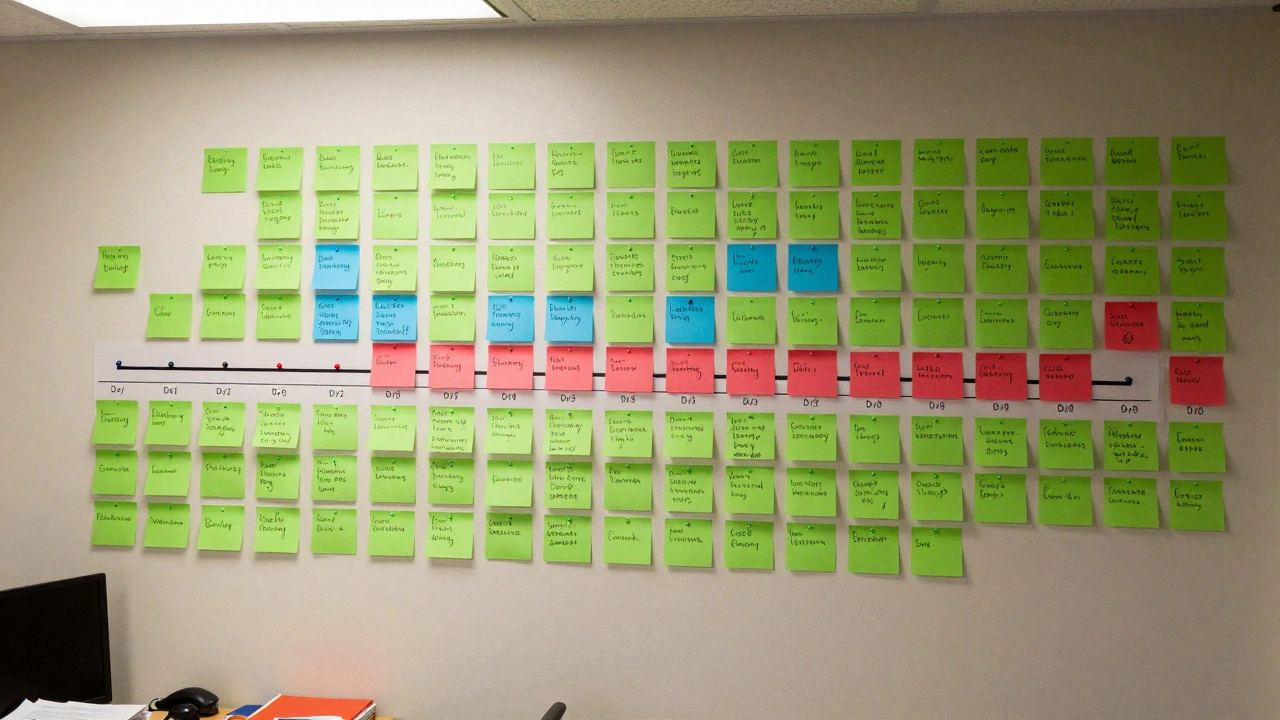
One student in Leeds used a wall chart with color-coded sticky notes. Each subject had its own color. She moved a pin each day. By exam season, her wall looked like a victory map.

How much time does this save?
Let’s say you have 10 topics to revise. If you review each one once a day for 10 days, that’s 100 sessions. At 20 minutes each? That’s over 33 hours.
With 2/3/5:7, you review each topic 4 times. 10 topics × 4 reviews = 40 sessions. At 15 minutes each? Just 10 hours.
You save 23 hours. And you remember more.
That’s not magic. That’s math.
Real results: A student’s story
Lily, 16, from Birmingham, failed her mock biology exam with 42%. She was ready to give up. Then her tutor showed her the 2/3/5:7 rule.
She started small. One topic per week. Used flashcards. Set alarms. After three weeks, she reviewed her first topic - photosynthesis - for the fourth time. She could explain it backwards. She was shocked.
By exam day, she got a 7 (A). Her biology teacher said it was the biggest improvement she’d seen in five years.
"I didn’t study more," Lily said. "I just studied smarter."
When should you start?
Start now. Don’t wait until March. The 2/3/5:7 rule works best when you spread it out over months. If you begin revision in January, you’ll hit your final review just before the exam - with zero stress.
Even if you’ve got 6 weeks left, it’s not too late. Pick your 3 hardest subjects. Apply the rule to one topic per day. You’ll still see a jump.
GCSEs aren’t about how long you study. They’re about how well you remember.
Is the 2/3/5:7 rule only for GCSEs?
No. The spacing effect works for any learning. Students use it for A-levels, university exams, medical school, and even language learning. But it’s especially powerful for GCSEs because the curriculum is packed with facts. If you’re memorizing anything - formulas, dates, vocabulary - this rule helps.
Can I use this for essay writing?
Yes - but differently. The rule is best for facts, not arguments. Use it to memorize quotes, key events, or data points. Then, practice writing essays using those facts. The rule ensures you’ve got the evidence locked in. Without it, you’ll struggle to recall the right example during the exam.
What if I forget to review on day 5?
Don’t panic. Just review as soon as you remember. Then reset the clock: do your next review 5 days after that day. You’ll lose a little efficiency, but you won’t lose everything. The goal is consistency, not perfection. Missing one review is better than skipping them all.
Do I need to make flashcards?
Not necessarily. Flashcards are popular because they’re easy to use with spaced repetition. But you can also use summaries, mind maps, self-quizzing, or teaching aloud. The key is active recall - trying to remember without looking. Flashcards just make that easier.
Is this better than past papers?
They’re not alternatives - they’re partners. Use the 2/3/5:7 rule to memorize the content. Then use past papers to practice applying it. Past papers show you how questions are asked. The revision rule ensures you know the answers. Use both.
Write a comment