

Adult Learning Concept Explorer
Click on a concept below to learn how it differs from traditional teaching methods and how to apply it in practice.
Definition: Andragogy is the method and practice of teaching adult learners. Unlike pedagogy (child-centered), it assumes learners are self-directed and bring rich life experiences to the table.
Pedagogy vs. Andragogy
| Child-Centric: | Dependent on teacher; subject-centered. |
| Adult-Centric: | Self-directed; problem-centered. |
You walk into a classroom, or maybe log onto a Zoom call, and realize something is off. The teacher is talking at you like you're back in high school, memorizing dates for a test you'll forget by lunch. But you aren't that kid anymore. You have a mortgage, a career, and probably a few scars from life lessons that no textbook could teach. This disconnect is why andragogy, the method of teaching adults, exists as a distinct concept from pedagogy (teaching children). It’s not just about changing the font size on the slides; it’s about fundamentally shifting how we view the learner.
If you’re an educator, a corporate trainer, or someone looking to upskill yourself, understanding the core concepts behind adult learning isn’t optional-it’s essential. Ignoring them leads to low engagement, wasted budgets, and frustrated learners who drop out before finishing the course. So, what actually works? Let’s break down the specific frameworks that drive successful adult education today.
The Shift from Pedagogy to Andragogy
Most people assume that how you learn math in fifth grade is the same way you learn project management in your thirties. It isn’t. Malcolm Knowles, often called the father of modern adult education, popularized the term andragogy in the 1960s. He argued that adults are self-directed and draw from their own experiences. Unlike children, who are dependent on teachers for content and pacing, adults need to know why they are learning something before they’ll commit to it.
This isn’t just theory. Think about the last time you had to sit through a mandatory compliance training session. If the facilitator started with "Open your books to page 4," you likely checked out mentally. If they started with, "Here’s how this new regulation saves you from getting sued," you leaned in. That’s andragogy in action. It respects the learner’s autonomy. In practice, this means educators must act less like sages on a stage and more like facilitators who guide discovery.
Self-Directed Learning: Taking the Wheel
Closely tied to andragogy is self-directed learning (SDL). This concept posits that adults take the initiative to diagnose their learning needs, formulate goals, identify resources, and evaluate outcomes. It’s the engine behind platforms like Coursera or MasterClass, where you choose exactly what you want to watch and when.
But SDL isn’t just about picking your own movies. It requires metacognition-thinking about how you think. Successful adult learners set specific, measurable goals. They don’t just say, "I want to learn Spanish." They say, "I want to hold a five-minute conversation with my neighbor in three months." Educators support this by providing scaffolding, not cages. Instead of rigid curricula, offer modular paths. Let learners skip what they already know. This respects their time, which is the most scarce resource adults have.
Experiential Learning: Doing Over Watching
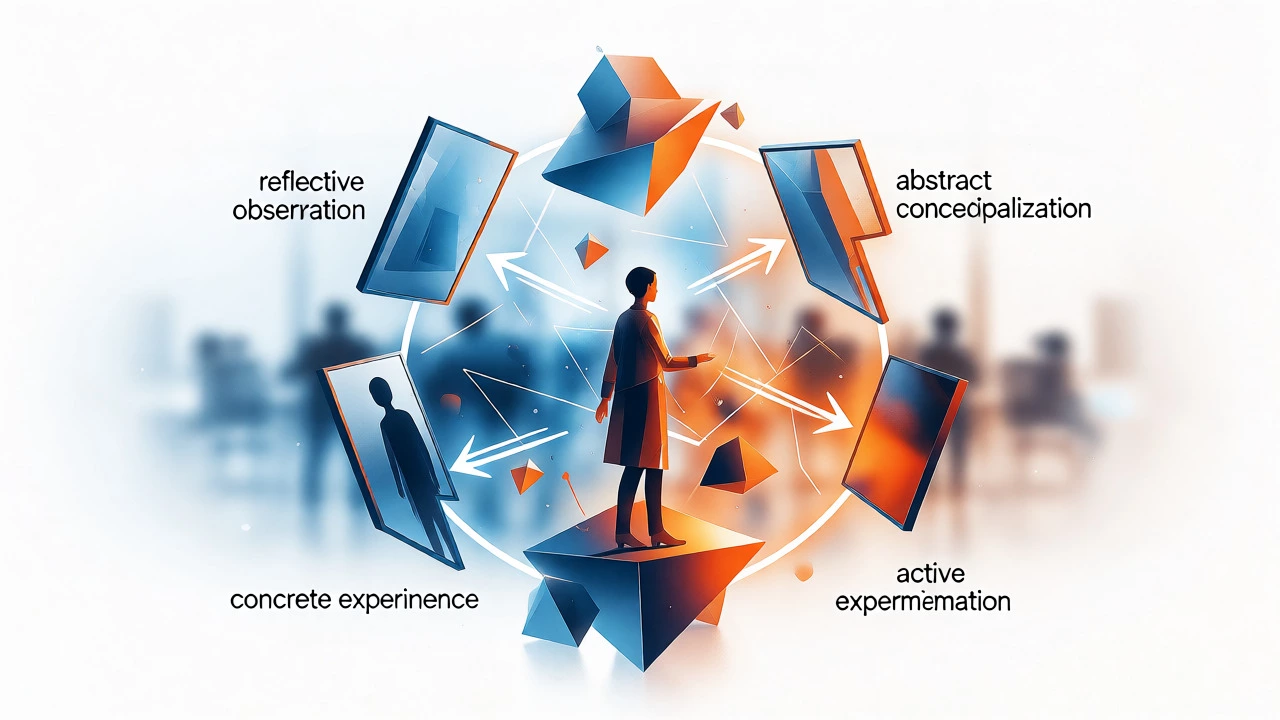
Have you ever tried to learn to ride a bike by reading a manual? It doesn’t work. You get on, wobble, fall, adjust, and try again. This cycle is the heart of experiential learning, a concept developed by David Kolb. Kolb’s model suggests that learning happens through four stages: concrete experience, reflective observation, abstract conceptualization, and active experimentation.
In adult education, this means simulations, case studies, and role-plays beat lectures every time. For example, a leadership workshop shouldn’t just list traits of good leaders. It should put managers in a simulated crisis where they have to make tough calls, then debrief on what happened. The reflection phase is critical here. Without pausing to analyze the failure or success, the experience is just noise. Facilitators must ask probing questions: "What triggered that reaction?" "How would you handle it differently next time?" This turns raw experience into durable knowledge.
| Feature | Pedagogy (Child-Centric) | Andragogy (Adult-Centric) |
|---|---|---|
| Learner Role | Dependent on teacher | Self-directed and autonomous |
| Experience | Limited; seen as irrelevant | Rich resource for learning |
| Motivation | External (grades, parents) | Internal (career growth, curiosity) |
| Orientation | Subject-centered | Problem-centered |
Transformative Learning: Changing the Lens
Sometimes, learning isn’t just about adding new facts; it’s about overturning old assumptions. Jack Mezirow introduced transformative learning, which describes the process of expanding consciousness through critical reflection. This often starts with a "disorienting dilemma"-an event that clashes with your existing worldview.
Imagine a seasoned engineer who believes automation will replace all jobs. Then, they take a course on human-AI collaboration. They realize their skills are complementary, not obsolete. Their perspective shifts. They stop fearing AI and start leveraging it. This shift is transformative. It’s deeper than skill acquisition because it changes identity. Educators foster this by creating safe spaces for debate and challenging participants to defend their viewpoints. It’s uncomfortable, but that discomfort is where growth lives.
Social Constructivism: Learning Together
We tend to think of learning as a solitary act-headphones on, eyes glued to a screen. But humans are social animals. Lev Vygotsky’s social constructivism argues that knowledge is co-created through interaction. For adults, peer learning is powerful because colleagues bring diverse professional contexts to the table.
A marketing manager from New Zealand might solve a problem differently than one from Singapore due to cultural nuances. When these two collaborate, both expand their mental models. Online forums, group projects, and mentorship circles leverage this. The key is structured interaction. Random chatter isn’t enough. Assign roles, require consensus-building, and encourage critique. This mirrors real-world workplaces, making the transfer of learning seamless.

Practical Application: Putting Concepts to Work
So, how do you apply these concepts tomorrow? Start small. If you’re designing a training program, audit it against these principles. Is there too much lecture and not enough doing? Are you assuming prior knowledge incorrectly? Here’s a quick checklist:
- Respect Autonomy: Allow learners to choose their pace or path where possible.
- Leverage Experience: Ask participants to share relevant stories early in the session.
- Focus on Relevance: Clearly state how the content solves a current pain point.
- Encourage Reflection: Build in breaks specifically for processing information, not just checking emails.
- Foster Community: Create opportunities for peers to teach each other.
Remember, adult learners are skeptical. They’ve been burned by bad training before. Your job isn’t to dazzle them with fancy tech, but to prove that you value their time and intelligence. When you treat them as partners rather than vessels to be filled, engagement skyrockets.
FAQ
What is the difference between pedagogy and andragogy?
Pedagogy refers to the method of teaching children, characterized by dependency on the teacher and subject-centered curriculum. Andragogy is the method of teaching adults, focusing on self-direction, problem-centered learning, and utilizing the learner's past experiences as a resource.
Why is self-directed learning important for adults?
Adults have busy lives and specific career goals. Self-directed learning allows them to take ownership of their education, choosing what, when, and how they learn. This increases motivation and ensures the learning is immediately applicable to their personal or professional needs.
How does experiential learning work in practice?
It follows Kolb's cycle: doing an activity (concrete experience), thinking about what happened (reflective observation), forming general theories (abstract conceptualization), and trying it again with adjustments (active experimentation). In classrooms, this looks like simulations, labs, or role-playing followed by debriefs.
Can online courses effectively use adult education concepts?
Yes. Platforms can support self-directed learning through modular content. Social constructivism is supported via discussion boards and peer reviews. Experiential learning can be simulated through interactive scenarios and virtual reality. The key is designing for interaction and relevance, not just passive video consumption.
What is transformative learning?
Transformative learning is a deep shift in perspective caused by critically examining our assumptions and beliefs. It often occurs after a disorienting dilemma forces us to question how we see the world. It results in a changed frame of reference, altering how we interpret future experiences.
Write a comment