

A-Level Math Algebra Practice Tool
Why This Matters
Strong algebra skills are the foundation of A-Level math. Over 70% of A-level problems require algebraic manipulation. Practice regularly to build the muscle memory you'll need for calculus, vectors, and more.
Start with 15 minutes daily. Don't skip steps. Write everything down. This tool simulates the exact algebra problems that will help you succeed.
Solve the problem:
Is A-level math hard? The short answer: yes - but not because you’re not smart enough. It’s hard because it asks you to think in ways you’ve never been asked to before. It’s not about memorizing formulas. It’s about seeing patterns, connecting ideas, and solving problems that don’t have obvious paths. If you’re coming from GCSE, you might feel like you’ve been handed a puzzle with half the pieces missing - and no picture on the box.
What makes A-level math different from GCSE?
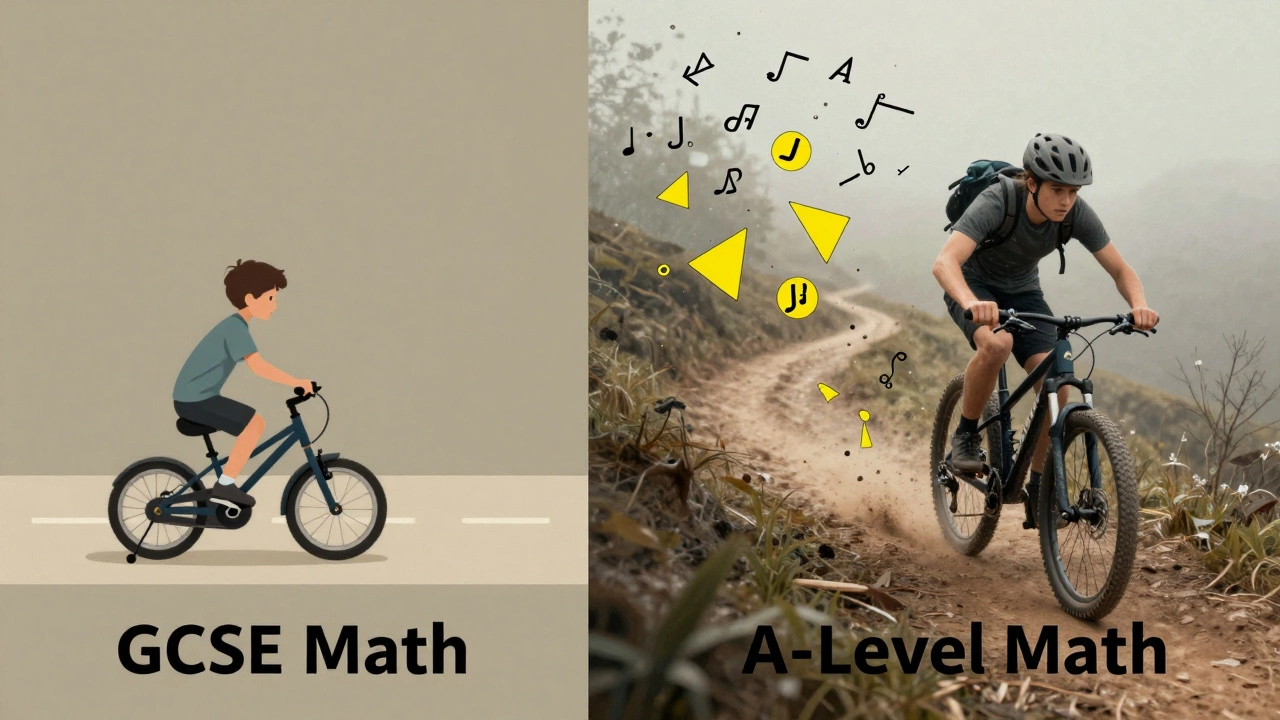
GCSE math is like learning to ride a bike with training wheels. You follow set routes, practice the same turns, and get feedback after every mistake. A-level math is like riding downhill on a mountain trail you’ve never seen before - and you’re expected to brake, turn, and adjust your balance while moving at full speed.
The jump isn’t just in complexity - it’s in abstraction. At GCSE, you solve equations. At A-level, you prove why those equations work. You don’t just calculate the area under a curve - you understand what that area represents in real-world terms, like total distance traveled or accumulated cost over time. You’re no longer just doing math. You’re learning to speak its language.
Core topics like calculus, logarithms, and vectors aren’t just new. They’re foundational. Miss one concept, and everything else starts to crumble. A mistake in differentiation in Year 12 can wreck your understanding of integration in Year 13. There’s no room for skipping ahead.
Who struggles the most with A-level math?
It’s not the “bad at math” students who fail. It’s the ones who think they’re fine because they got a 7 or 8 at GCSE. They assume A-level will be more of the same. That’s the trap.
The real struggle comes from three places:
- Reliance on memorization - If you learned GCSE by drilling past papers, you’ll hit a wall. A-level doesn’t repeat questions. It repeats concepts.
- Weak algebra skills - Over 70% of A-level math problems require manipulating algebraic expressions. If you still get stuck simplifying fractions or expanding brackets, you’re fighting an uphill battle.
- Avoiding the hard stuff - Many students skip the proof questions, avoid word problems, and ignore the “show that” parts. Those are the exact questions that separate A* from B grades.
A 2023 report from the UK’s Joint Mathematical Council found that students who scored below a 6 at GCSE had less than a 20% chance of getting a C or above at A-level. But those who scored a 7 or higher - and still practiced daily - had a 68% pass rate. It’s not about raw talent. It’s about consistency.
What’s actually on the exam?
Most A-level math courses follow the same structure: Pure Maths (about 60%), Mechanics (20%), and Statistics (20%). But what does that mean in practice?
Pure Maths covers:
- Calculus - differentiation and integration of polynomials, trig functions, exponentials
- Algebra - solving complex equations, partial fractions, binomial expansion
- Functions - transformations, inverses, domains, ranges
- Trigonometry - radians, identities, solving equations with multiple angles
- Vectors - 3D lines, dot products, geometric applications
Mechanics is physics in math form:
- Forces, motion, Newton’s laws
- Projectiles - calculating range, time of flight, maximum height
- Friction, momentum, energy
Statistics isn’t just averages and charts:
- Probability distributions - binomial, normal
- Hypothesis testing - what’s the chance this result happened by luck?
- Correlation and regression - how do two variables really relate?
It’s not the volume of topics that breaks people. It’s the depth. One question might ask you to model the speed of a falling object using calculus, then use statistics to test if your model matches real-world data. You’re not just doing math. You’re doing engineering, physics, and data science - all in one problem.
How to actually pass A-level math
Here’s the truth: you don’t need to be a genius. You need to be consistent.
Start with this:
- Master algebra - every day. Spend 15 minutes before each study session solving 5 algebra problems. No calculator. No shortcuts. Just pen and paper. This builds the muscle memory you’ll need for everything else.
- Don’t just do past papers - reverse-engineer them. After solving a question, ask: “What concept is this testing?” and “What would happen if I changed this number?”
- Learn to write full solutions. Examiners don’t just care about the answer. They care about how you got there. If you skip steps, you lose marks - even if you’re right.
- Find your weak spot and kill it. If you freeze up on trig identities, drill them until they’re automatic. If you hate mechanics, draw every diagram. Visuals make abstract ideas real.
- Work with others. Join a study group. Explain a concept to someone else. Teaching is the fastest way to learn.
One student I worked with - let’s call her Sam - got a 5 at GCSE. She thought she’d fail A-level. But she started doing 10 algebra problems every morning, wrote out every step in her homework, and asked one question in class every day. By the end of Year 13, she got an A. Not because she was brilliant. Because she refused to give up on the small stuff.
What if you’re falling behind?
It’s not too late. Even if you’re halfway through Year 12 and feel lost, you can still turn it around - but you need to act now.
Here’s what to do:
- Diagnose the gap. Look at your last three tests. What topic came up again and again? That’s your focus.
- Rebuild from the basics. If you don’t understand how to factorize quadratics, don’t move on to calculus. Go back. Watch a YouTube video. Use a textbook. Relearn it like you’re starting from zero.
- Ask for help - early. Don’t wait until the exam season. Talk to your teacher. Find a tutor. Use free resources like DrFrostMaths or Physics & Maths Tutor.
- Track progress weekly. Keep a log: “Today I understood how to integrate e^x.” Small wins build confidence.
There’s no magic fix. But there is a path: show up, do the work, and don’t let one bad test define you.

Is it worth it?
Yes - if you want to study engineering, physics, computer science, economics, or even psychology at university. A-level math is the gatekeeper. But even if you’re not going into a STEM field, the skills matter.
It teaches you how to break down chaos into logic. How to spot patterns in noise. How to keep going when the answer isn’t obvious. Those aren’t just math skills. They’re life skills.
And if you get through it? You’ll look back and realize: you didn’t just pass a hard exam. You proved you could learn something hard - and that’s the kind of thing that changes your future.
Is A-level math harder than other A-level subjects?
A-level math is consistently ranked as one of the hardest A-levels, but not because it’s “impossible.” It’s harder than subjects like English or history because it’s cumulative - every new topic builds on the last. If you miss a concept, it affects everything after. Subjects like psychology or sociology rely more on memory and essay structure, which are easier to catch up on. Math doesn’t forgive gaps.
Can you do A-level math without doing Further Maths?
Absolutely. Most students take just the standard A-level math. Further Maths is an extra A-level that adds even more advanced topics like complex numbers, matrices, and hyperbolic functions. It’s only needed if you’re applying to top-tier math, physics, or engineering programs at universities like Oxford, Cambridge, or Imperial. For most courses, standard A-level math is enough.
What grade do you need at GCSE to take A-level math?
Most schools require a 6 or higher at GCSE, but some will accept a 5 if you show strong motivation and extra support. A 7 or above gives you a much better chance of success. If you’re borderline, talk to your teacher. Many schools offer bridging courses over the summer to help students catch up on key algebra and trig skills before Year 12 starts.
How much time should you spend on A-level math each week?
Aim for at least 5-7 hours per week outside of class. That’s about an hour a day, five days a week. Don’t cram. Spread it out. One focused hour where you solve 5 problems properly is better than three hours of mindless revision. Use weekends for past papers and reviewing mistakes.
Do you need a calculator for A-level math?
Yes - but not as much as you think. You’ll need a scientific calculator with functions like sin, cos, tan, logs, and statistical modes. But the exam is designed so you can’t rely on it. Many questions test your ability to solve without a calculator. Practice doing key steps by hand. The calculator is a tool, not a crutch.
What’s the pass rate for A-level math?
The overall pass rate (A*-E) is around 97%, but that’s misleading. The real challenge is getting a high grade. Only about 12% of students get an A*, and roughly 25% get an A. The average grade is a C. Most students pass - but many don’t reach the grades they need for university courses. Success depends on preparation, not luck.
Next steps if you’re taking A-level math
Start now. Even if your course hasn’t begun, get a copy of the Edexcel or AQA specification. Look at the topics for Year 12. Pick one - maybe algebra or trigonometry - and spend 20 minutes a day reviewing it. Use free resources like CorbettMaths or Khan Academy. Build the habit before the pressure hits.
Don’t wait until you’re drowning to ask for help. Talk to your teacher before the first test. Form a study group with classmates. Write down your questions as they come up. And remember: you’re not alone. Every student who’s ever passed A-level math felt lost at some point. The difference? They kept going.
Write a comment