
GCSE Subject Prioritization Calculator
Optimize your 3-month revision
Based on the article: Focus on subjects where you have the most improvement potential AND highest exam weight. This calculator shows you which subjects should get 70% of your time.
Current GCSE Grade
Your current grade (1-9 scale)
Exam Weighting
Percentage of exam this subject represents
Three months. That’s all you’ve got before your GCSEs start. You’ve been putting it off. Maybe you’re still in Year 10, or maybe you missed the early start. Now you’re staring at a mountain of topics and wondering: Is 3 months enough to revise for GCSE? The short answer? Yes - if you know how to use the time. Not just any way. Not by cramming. Not by watching YouTube summaries while scrolling TikTok. But with real strategy, real focus, and real rhythm.
What 3 months of GCSE revision actually looks like
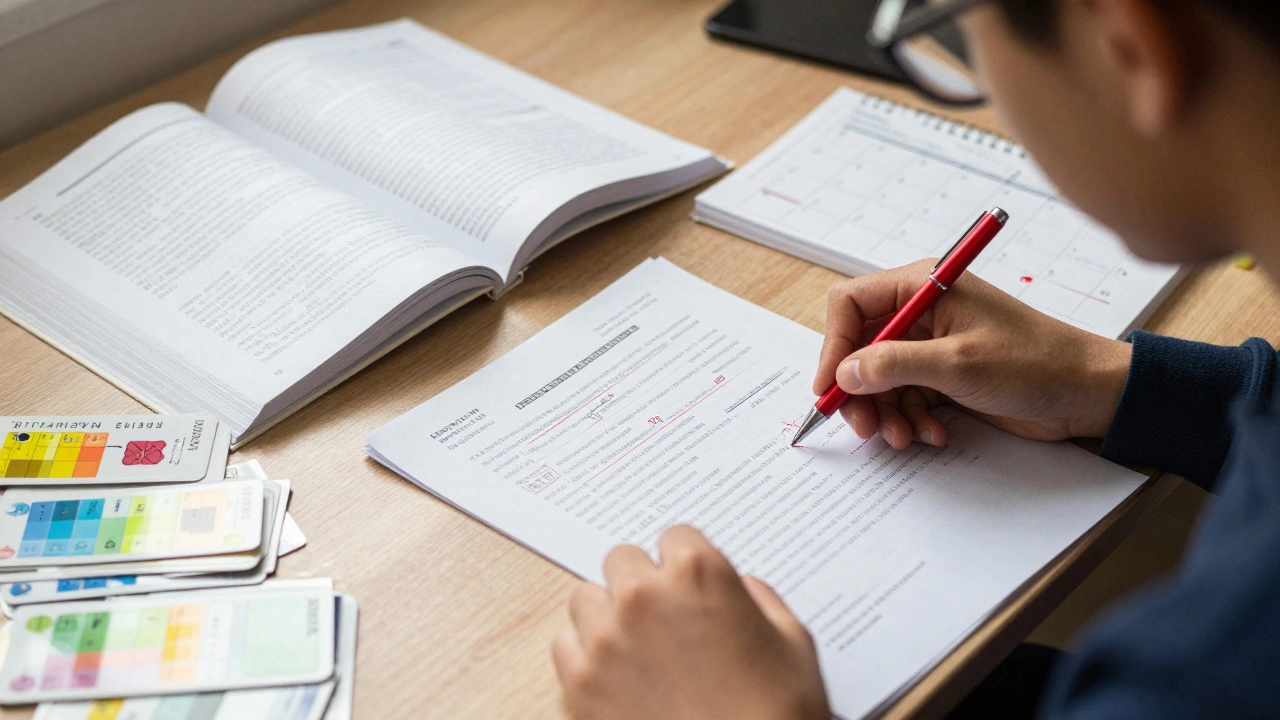
Most students think revision means reading notes over and over. That’s not revision. That’s pretending you’re studying. Real revision is active. It’s testing yourself. It’s explaining concepts out loud. It’s doing past papers under timed conditions. In three months, you’re not trying to learn everything from scratch. You’re rebuilding what you already half-know.
Think of your brain like a computer with half-finished files. Your classwork, homework, and mock exams are the data. Three months is your chance to sort, clean, and backup those files - not download new ones.
Here’s what a realistic 3-month plan looks like:
- Month 1: Audit and Prioritize - List every topic in every subject. Mark what you’re confident in, what you’re shaky on, and what you don’t remember at all. Focus on the high-weight topics first. For example, in Maths, algebra and graphs make up nearly 40% of the exam. Don’t waste time on niche geometry questions if you haven’t mastered simultaneous equations yet.
- Month 2: Build Routine and Practice - Start doing one past paper per subject every week. Don’t just write answers - mark them like an examiner. Use the official mark schemes. Note where you lose marks: careless errors? Misreading questions? Not showing working? Fix those patterns.
- Month 3: Simulate and Refine - Do full exams under real conditions: timed, no phone, no breaks beyond the official 10 minutes. Get used to the pressure. Then review every mistake. Why did you get it wrong? Was it knowledge, speed, or stress?
Why most students fail with 3 months - and how to avoid it
The biggest reason students burn out after 6 weeks? They treat revision like a checklist. ‘Did I read Biology Unit 3? Check.’ ‘Did I watch the Maths revision video? Check.’ But checking off tasks doesn’t build memory. Spaced repetition does. Active recall does.
Here’s what science says: You forget 70% of what you learn within 24 hours if you don’t revisit it. So if you study Chemistry on Monday and don’t touch it until Friday, you’ve lost most of it. But if you test yourself on Monday, then again on Wednesday and Saturday, you’re locking it in.
Use flashcards - physical or digital like Anki. Spend 15 minutes a day, not 2 hours once a week. Do 10 minutes of flashcards after breakfast. Do 10 more before bed. That’s 20 minutes. That’s all it takes to keep a topic alive in your memory.
Another mistake? Waiting until you ‘feel ready’. You’ll never feel ready. Not if you’re aiming for a 7 or above. The only way to know you’re ready is to have done enough past papers that the questions feel familiar. Not easy - familiar.
How to pick the right subjects to focus on
You can’t do everything equally. That’s impossible in three months. So be ruthless.
Start with your weakest subject that also has the highest grade potential. For example:
- If you’re stuck at a 4 in English Literature but you’re decent at writing, you can jump to a 6 or 7 with focused essay practice.
- If you’re at a 5 in Physics but struggle with equations, focus on the 5 most common question types. They show up every year.
- If you’re borderline on a 4 in Maths and you hate statistics, skip the trickier probability questions. Master the basics: averages, fractions, percentages, and graphs. That alone can get you to a 5.
Look at the exam board’s topic weightings. For AQA English Language Paper 2, the non-fiction analysis section is worth 32 marks. That’s more than half the paper. If you can nail that, you’re halfway to a 7. Don’t waste hours on poetry you hate.
Also, don’t ignore your strong subjects - but don’t overdo them. Spend 20% of your time on subjects you’re already good at. That’s enough to keep them sharp and build confidence. Put 80% into the ones dragging your average down.

Tools that actually help - not distract
There are hundreds of apps, YouTube channels, and revision websites. Most are noise.
Use these, and only these:
- Physics & Maths Tutor - Free past papers, mark schemes, and topic questions for all exam boards. No ads. No fluff.
- Seneca Learning - Free, interactive revision that tests you as you go. Great for Biology, Chemistry, and Geography.
- Anki - Free flashcard app that uses spaced repetition. Set it up once, and it reminds you when to review.
- Google Calendar - Block out 90-minute slots for each subject. Treat them like appointments. No skipping.
Stop using TikTok revision clips. They’re entertaining, not effective. You’ll remember the joke, not the equation.
What to do on the day you feel like giving up
There will be days - probably around Week 6 - when you’re exhausted. You’ve done 30 past papers. You’ve memorized 500 flashcards. And you still feel lost.
That’s normal. It doesn’t mean you’re failing. It means you’re in the middle of the learning curve.
On those days:
- Do one easy past paper - just to remind yourself you can still do it.
- Teach one topic to a friend, a pet, or a mirror. Explaining it out loud forces your brain to organize the information.
- Go for a 20-minute walk. No phone. Just movement. Your brain needs space to process.
Don’t punish yourself. Don’t say, ‘I should’ve started earlier.’ That’s energy wasted. Focus on the next 24 hours. What can you do today that’s better than yesterday?
Real results: What students who did it in 3 months actually achieved
Last year, a student in Manchester had a 3 in Science and 4 in Maths after mocks. She had three months. She did 2 past papers a week, used Anki daily, and focused only on high-mark topics. She ended up with a 7 in Science and a 6 in Maths.
A boy in Birmingham was averaging a 4 in English. He stopped reading novels. He spent 45 minutes a day writing timed essays using past paper prompts. He got an 8.
These aren’t geniuses. They just stopped hoping and started doing.
GCSEs aren’t about how much you know. They’re about how well you can show what you know under pressure. Three months is enough to train your brain to do that.
Final checklist: Are you on track?
By the end of Month 2, ask yourself:
- Have I done at least 1 past paper per subject?
- Do I know where I lose marks - and can I fix it?
- Do I have a daily revision habit that doesn’t rely on motivation?
- Have I cut out distractions that waste time - not just social media, but also endless note-making?
If you can answer yes to those, you’re not just ready. You’re ahead of 80% of the students who started six months ago.
Is 3 months enough to revise for GCSE if I’ve been slacking all year?
Yes - but only if you stop pretending you’re studying. Slacking all year means you’re starting from a deficit, not zero. You still remember more than you think. Focus on active revision: past papers, flashcards, and timed practice. Skip the re-reading. Skip the highlighters. Do the work that builds memory, not just noise.
Can I revise for 8 GCSEs in 3 months?
You can, but you shouldn’t treat them all the same. Prioritize. Pick 3-4 subjects that are your biggest weaknesses and give them 70% of your time. The rest get 10-15 minutes a day to stay fresh. Don’t try to be perfect in everything. Be strong in enough to hit your target grades.
What’s the best daily revision schedule for 3 months?
Start with 90 minutes a day, split into two 45-minute blocks. One block for active recall (flashcards, quizzes), one for past papers or essay practice. Add 10 minutes of review before bed. On weekends, do one full past paper. That’s 6-7 hours a week - enough to build momentum without burnout.
Should I drop a GCSE subject if I’m behind?
Only if you’re aiming for a grade below a 4 and it’s not required for your next steps. Most sixth forms and colleges need at least five GCSEs at 4 or above, including English and Maths. Dropping a subject won’t save you time - it’ll just leave a gap. Better to focus on passing the core ones and giving the others just enough attention to scrape a 4.
How do I stay motivated when I’m tired?
Motivation fades. Discipline stays. Set tiny wins: ‘Today, I’ll do one flashcard set and one past paper question.’ Celebrate those. Don’t wait for big milestones. Also, tell someone your goal - a friend, a parent, a teacher. Accountability helps more than you think.
What comes next
Once your GCSEs are done, you’ll have choices: A-levels, apprenticeships, college, or work. But right now, focus on the next 90 days. Not the next year. Not the next decade. Just the next 90 days.
You don’t need to be perfect. You just need to be consistent. One flashcard. One past paper. One day at a time.
Three months isn’t a lot. But it’s more than enough - if you stop waiting and start doing.
Write a comment