

GCSE to US Grade Converter
Convert GCSE to US Letter Grade
GCSEs use a 9-1 scale where 9 is highest and 1 is lowest. This tool shows how they translate to US letter grades.
Result will appear here
Enter a GCSE grade to see the US equivalent
GCSE to US Grade Comparison
Ever tried explaining GCSEs to an American friend and watched their face go blank? You say "I took ten GCSEs," and they reply, "Wait, like... finals?" It’s not their fault. The UK education system doesn’t map neatly onto the American one. But if you’ve ever had to break it down-whether you’re a student, a parent, or just someone trying to make sense of a British cousin’s report card-you know how confusing it can be.
What exactly are GCSEs?
GCSE stands for General Certificate of Secondary Education. It’s not a single test. It’s a set of subject-based qualifications that most students in England, Wales, and Northern Ireland take between ages 14 and 16. Think of them as the culmination of Key Stage 4, the final two years of compulsory secondary education. Students usually take between 8 and 10 GCSEs, covering core subjects like English, Maths, and Science, plus electives like History, Art, or Computer Science.
Unlike American high school, where grades are averaged over four years and report cards come out every term, GCSEs are decided almost entirely by final exams taken at the end of Year 11 (age 15-16). Coursework and controlled assessments matter in some subjects-like Art or Design & Technology-but for most, it’s all about how you do on those exam papers.
How do GCSE grades work?
This is where Americans get really lost. In the U.S., you get letter grades: A, B, C, D, F. In England, GCSEs use numbers from 9 to 1, with 9 being the highest. A 9 is harder to get than the old A* used to be. Here’s the rough translation:
- 9 = Exceptional performance (top 3% of students)
- 8 = High A*
- 7 = Solid A*
- 6 = High A
- 5 = Strong pass (equivalent to a low A or high B)
- 4 = Standard pass (equivalent to a C)
- 3 = Below standard pass
- 2 = Low
- 1 = Very low
Most schools and employers expect at least a grade 4 in English and Maths. A grade 5 is often called a "strong pass" because it’s the benchmark for many sixth forms and colleges. If you got a 4 in English and a 6 in Maths? That’s perfectly respectable.
GCSEs vs. American High School: The Big Differences
Let’s cut through the noise. Here’s how the two systems actually compare:
| Aspect | GCSEs (UK) | U.S. High School |
|---|---|---|
| Duration | 2 years (Years 10-11) | 4 years (Grades 9-12) |
| Assessment | Mostly final exams | Continuous grading: homework, projects, quizzes, finals |
| Grading Scale | 9-1 (9 = highest) | A-F (A = highest) |
| Number of Subjects | 8-10 focused subjects | 6-8 subjects per year, spread over 4 years |
| Post-16 Path | A-levels, BTECs, apprenticeships | College prep, vocational tracks, community college |
| College Admissions | A-levels matter more; GCSEs are background checks | High school GPA and SAT/ACT are central |
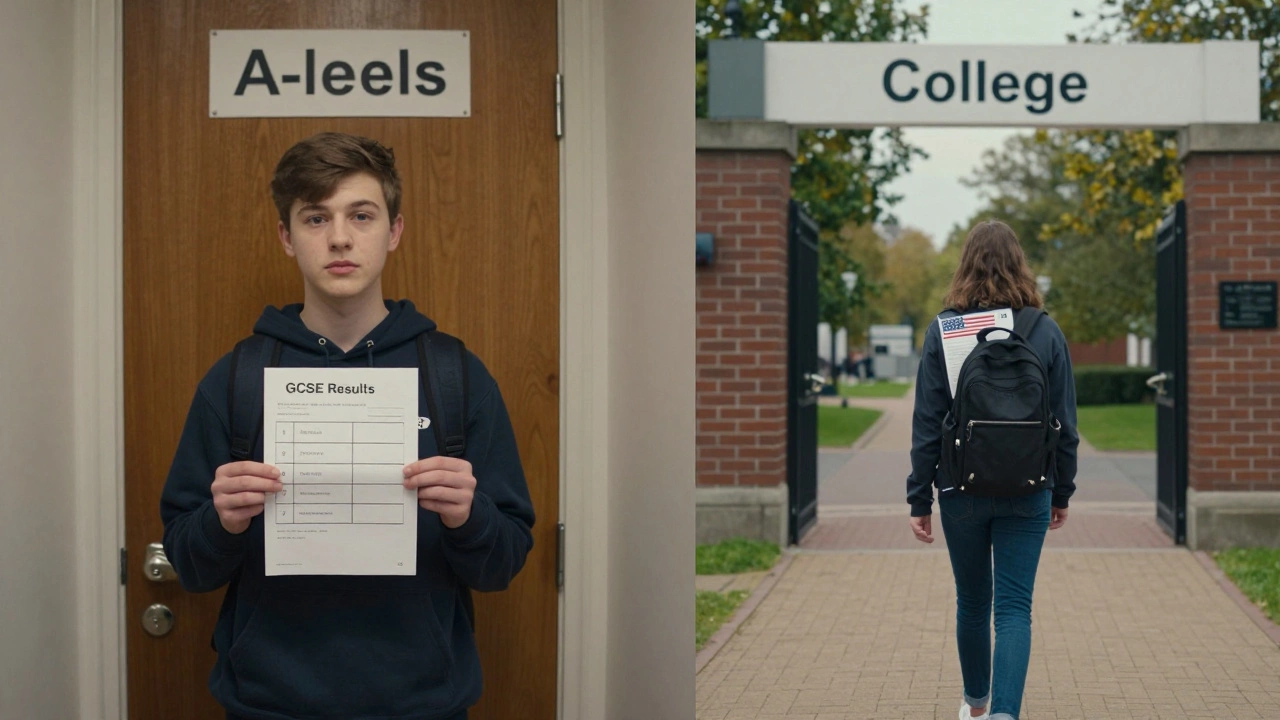
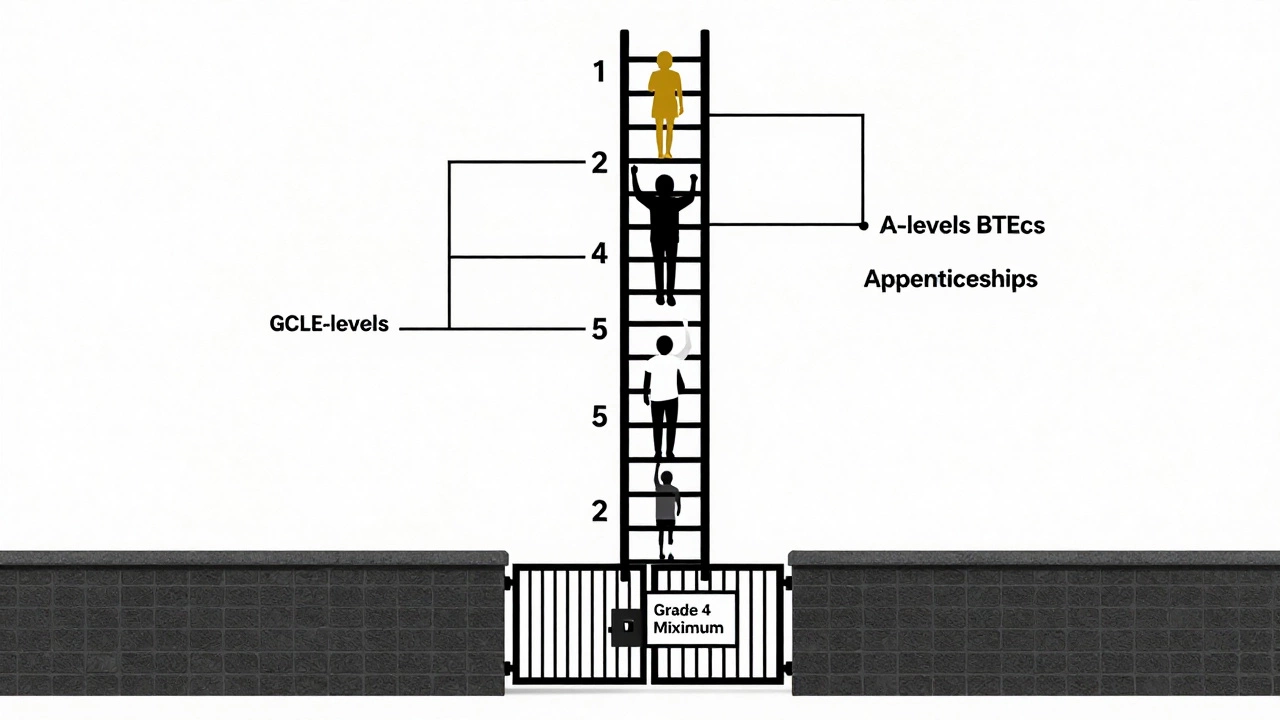
One of the biggest shocks for Americans? GCSEs aren’t used for college admissions in the UK. That’s where A-levels come in. GCSEs are more like a gatekeeper: if you didn’t get a 4 in English and Maths, you can’t go to most sixth forms. But once you’re in, your A-level grades are what get you into university. It’s like the SATs and GPA combined-but split into two stages.
Why does this matter?
If you’re an American trying to understand a British teenager’s academic life, it’s not just about grades. It’s about pressure. GCSEs are high-stakes. Students are told repeatedly: "Your GCSEs will determine your future." That’s not hyperbole. A grade 3 in Maths might block access to A-level Maths, which blocks engineering degrees, which blocks careers. There’s no second chance. You take them once. At 16.
Compare that to the U.S., where students can retake classes, improve GPAs, or even switch schools. The UK system is more rigid. It’s also more focused. You don’t take 12 subjects a year. You pick a core set and go deep. That’s why British students often know more about their subjects by 16 than American juniors do.
What do Americans think of GCSEs?
When Americans hear "GCSE," they often assume it’s like the SAT or AP exams. It’s not. The SAT is a single test measuring general aptitude. AP exams are college-level tests taken by motivated high schoolers. GCSEs are the baseline national curriculum assessment for all students.
Some Americans are impressed. They like the focus. They admire how British students specialize early. Others think it’s too rigid. "What if a kid blossoms at 17?" they ask. Fair point. But the system assumes you’ll know your path by 16. And for many, that works.
For international students applying to UK schools, GCSEs are sometimes used as a benchmark. A U.S. student applying to a British sixth form might be asked to submit their transcript and be told: "You need the equivalent of at least four GCSEs at grade 5 or above." That’s not a joke. It’s a real requirement.
How to explain it in one sentence?
"GCSEs are the final national exams British students take at age 16, covering core and elective subjects. They’re graded 9-1, and while they don’t get you into university, they determine whether you can even enter the next level of education."
Real-world example
Imagine a 16-year-old in London named Maya. She got a 9 in Maths, an 8 in Physics, a 7 in English Literature, a 6 in Chemistry, a 5 in History, and a 4 in French. Her parents are thrilled. Her school says she’s on track for A-levels in Maths, Physics, and Chemistry. She’s aiming for engineering at Imperial College.
Now imagine a 16-year-old in Texas named Jake. He got a 3.8 GPA, took Honors Chemistry, scored a 1420 on his SAT, and is applying to the University of Texas. He took eight classes this year: English, Algebra, Biology, History, Spanish, PE, Art, and Computer Science.
Both are smart. Both are hardworking. But their systems are built differently. Maya’s path is narrower but deeper. Jake’s is broader but more spread out. Neither is better. Just different.
What happens after GCSEs?
After GCSEs, students choose their next step:
- A-levels: Two or three subjects studied in depth over two years. Required for university.
- BTECs: Vocational qualifications in areas like engineering, health, or business. More practical, less exam-focused.
- Apprenticeships: Paid work combined with part-time study. Popular in trades, tech, and finance.
- International Baccalaureate (IB): Less common, but offered by some private schools. More global in scope.
No one path is "right." But GCSEs are the filter. If you didn’t pass the basics, you’re locked out of most options.
Are GCSEs required to go to college in the UK?
Not directly. You need A-levels (or equivalent) to get into university. But GCSEs are the gate. Most sixth forms require at least five GCSEs at grade 4 or above-including English and Maths-to even enroll in A-levels. Without them, you’re stuck in vocational courses or have to retake them.
Is a GCSE grade 4 the same as a passing grade in the U.S.?
Roughly, yes. A grade 4 is considered a "standard pass" and is equivalent to a low C or high D in the old letter grading system. In the U.S., a D is often failing, but in the UK, a 4 is the minimum to move forward. It’s not excellent, but it’s enough to qualify for the next step.
Can American students take GCSEs?
Yes, but only if they’re enrolled in a UK-based school or an international school that offers the UK curriculum. The exams are administered by exam boards like Edexcel or AQA, and you can’t just walk in and take them. Most American students don’t take GCSEs unless they’re living in the UK or attending a British-style international school.
Do U.S. colleges care about GCSEs?
They might look at them if you’re applying from the UK, but they care far more about your A-level results, IB scores, or SAT/ACT. GCSEs are seen as a foundation, not a deciding factor. A strong A-level profile can easily outweigh lower GCSE grades.
Why are GCSEs so stressful for British teens?
Because they’re the first major academic gate. Your results determine what A-levels you can take, which affects your university options, which shapes your career path. There’s no do-over. You take them once, at 16. And society treats them like a life-defining moment. It’s pressure no 16-year-old should carry-but they do.
Final thought
GCSEs aren’t just exams. They’re a cultural artifact. A system built on early specialization, high stakes, and clear thresholds. Americans don’t have anything quite like it. And that’s okay. Understanding it doesn’t mean you have to agree with it. But if you’re talking to someone from the UK, knowing what GCSEs really mean helps you see their world a little clearer.
Write a comment