

A-level University Entry Requirements Checker
Check Your University Entry Requirements
Enter your expected A-level grades and select a university course to see if you meet the entry requirements.
If you’re trying to understand how A-levels work in England, you’re not alone. Every year, over 700,000 students take them, and they’re the main route into university for most teenagers. But the system isn’t as simple as it sounds. There are rules, deadlines, subject choices, and grading scales that can trip you up if you don’t know them. This isn’t about theory-it’s about what actually happens in real life, from picking your subjects to getting your results.
What are A-levels, really?
A-levels stand for Advanced Level qualifications. They’re not just exams-you spend two years studying a few subjects in depth, usually starting at age 16 after finishing GCSEs. Unlike GCSEs, where you might take 8-12 subjects, A-levels are focused. Most students pick three or four subjects to study full-time. That’s it. No more. And you’re expected to go deep, not broad.
These subjects aren’t chosen randomly. They’re often tied to what you want to study at university. Want to study engineering? You’ll need Maths and Physics. Medicine? Biology and Chemistry are non-negotiable. Law? English Literature and History often make the cut. Universities don’t just look at grades-they look at whether your subjects match your chosen course.
How are A-levels structured?
A-levels are split into two parts: AS Level and A2 Level. Back in the day, AS was a separate qualification you took after Year 12, and A2 came after Year 13. But since 2015, that changed. Now, AS is still taken in Year 12, but it’s no longer part of your final A-level grade. It’s a checkpoint. Your final A-level grade comes only from the exams you take at the end of Year 13.
Most subjects are assessed through written exams at the end of two years. But some, like Art, Design & Technology, or Drama, include coursework or practical assessments. For example, a student doing A-level Art might spend months building a portfolio of work that counts for 60% of their final grade. The rest comes from a timed exam where they create new pieces under supervision.
There’s no coursework in subjects like Maths, Physics, or Economics. Everything hinges on those final exams. That means if you have a bad day, it can really hurt. No second chances. No resits during the year. You get one shot.
What subjects can you take?
There are over 40 A-level subjects offered in England. But not every school offers all of them. If you want to study Latin, Ancient History, or Further Maths, you might need to find a school that has the staff and resources. Some students even travel to nearby schools or take online courses just to get the subject they need.
Here are the most common ones:
- Maths
- English Literature
- Biology
- Chemistry
- Physics
- History
- Geography
- Psychology
- Economics
- Art & Design
- Computer Science
- Sociology
- Modern Foreign Languages (French, Spanish, German)
Some subjects are considered "facilitating subjects" by top universities-meaning they’re preferred for competitive degrees. These include Maths, Physics, Biology, Chemistry, History, Geography, Modern and Classical Languages, and English Literature. If you’re aiming for Oxbridge or other elite universities, sticking to these can help.
How are A-levels graded?
A-levels are graded from A* to E. A* is the highest. If you score below an E, you get a U-unclassified-and it doesn’t count. That’s a fail.
Grades are based on a points system. An A* is worth 56 UCAS points, an A is 48, a B is 40, and so on down to an E at 16. These points matter because universities use them to set entry requirements. For example, a university might ask for ABB, which means you need an A in one subject, and Bs in the other two.
But here’s the catch: it’s not just about the final grade. The exam boards-Edexcel, AQA, OCR, and Cambridge Assessment-each have their own style. Some are harder in certain subjects. A student taking Biology with OCR might find the questions more application-based, while AQA leans toward memorization. Teachers often know which exam board their school uses and tailor lessons accordingly.

When do you take them?
A-levels are a two-year course. You start in September of Year 12, which is usually the year you turn 16. You take your AS exams in May or June of that year. Then you continue into Year 13, where you study the full A-level content and sit your final exams the following summer.
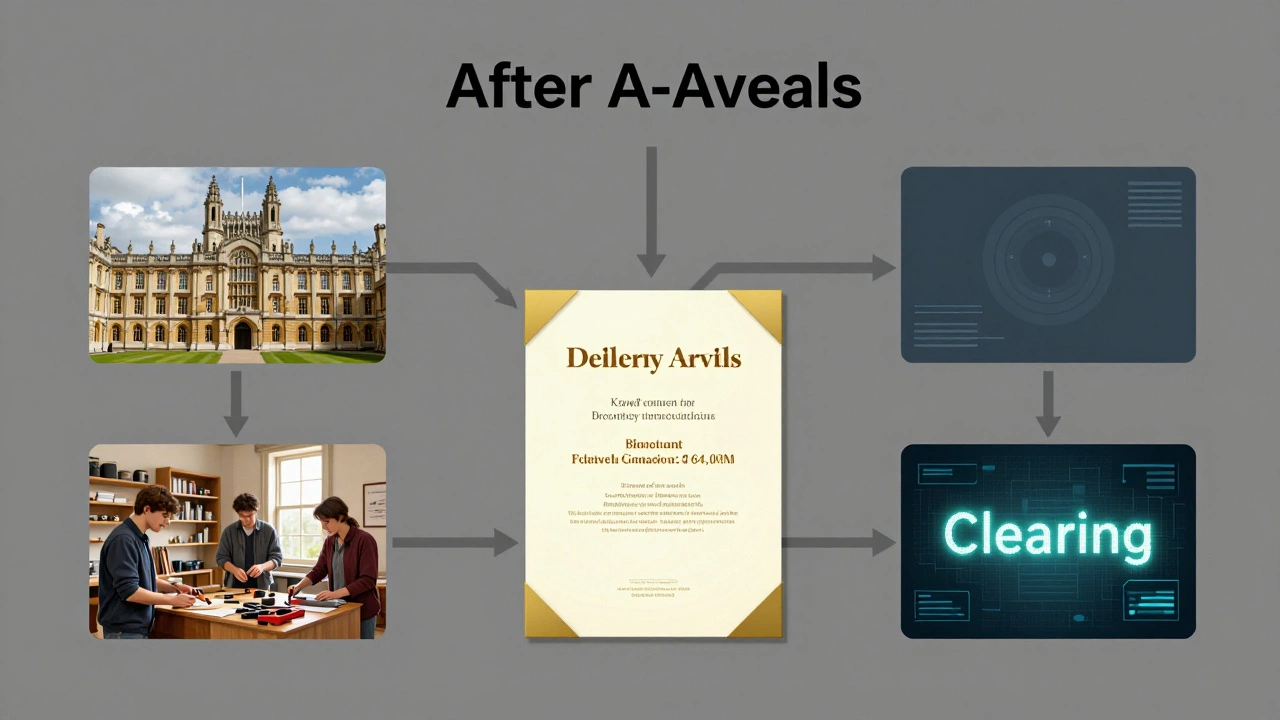
Results come out in mid-August. That’s the same day as GCSE results, so schools get packed. Students crowd around notice boards, phones buzz with messages, and some cry. Others celebrate. The grade you get that day determines whether you get into your chosen university-or if you have to go through clearing.
Clearing is a system that matches students who didn’t get the grades they needed with universities that still have space. It’s not a backup-it’s a real second chance. Thousands of students end up at great universities through clearing every year.
What if you don’t get the grades?
You can resit. Most subjects allow you to retake exams in the following June. Some students take a gap year to reapply. Others retake just one subject. If you got a C in Maths but need a B for your course, you can focus on that one paper. Schools often let you stay on for an extra term to prepare.
But resits aren’t easy. You’re competing with new students. The exam papers change slightly each year. And you have to stay motivated when everyone else has moved on. It’s harder than it sounds.
How do universities use A-levels?
Universities in England use A-level grades as their main way of deciding who to accept. The UCAS system lets you apply to five universities. Each one sets its own entry requirements. For example:
- University of Manchester: AAB in three A-levels
- University of Edinburgh: AAA
- University of Bath: A*AA
- University of Sussex: BBB
Some courses also require specific subjects. A medicine degree might ask for A-level Biology and Chemistry with grades of A*AA. A computer science course might want Maths at A or above. If you don’t meet those subject requirements, even with high grades, you’ll be rejected.
There’s also the personal statement and reference letter. But if your grades don’t meet the minimum, those won’t save you. Grades come first.
What about international students?
International students can take A-levels too, but they usually do so through private colleges or international schools in England. Some countries offer equivalent qualifications-like the IB (International Baccalaureate) or AP exams in the US. Universities accept those, but they’re not the same. An IB score of 38 might be seen as equal to A*AA in A-levels, but it’s not a direct match. Each university has its own conversion table.
If you’re coming from outside the UK, you’ll need to check what your qualifications are worth. Some students end up taking an extra year of A-levels just to meet the entry bar.
Are A-levels changing?
There’s been talk about reforming A-levels for years. Some say they’re too stressful, too narrow, and too focused on exams. Others argue they’re the best way to prepare students for university-level work.
In 2024, the Department for Education announced a pilot program in 12 schools to test a new model: combining A-levels with vocational elements. Think of it as A-levels with real-world projects-like building a business plan in Economics or running a science experiment in Biology. It’s not nationwide yet, but it’s a sign things might shift.
For now, though, the system stays the same. Three subjects. Two years. Final exams. One grade. No second chances.
What comes after A-levels?
Most students go to university. But not all. Some enter apprenticeships-especially in engineering, IT, or healthcare. Others join the workforce directly. A-levels open doors, but they don’t lock you into one path.
If you get a high enough grade, you might get a scholarship. Some universities offer automatic funding for students who get A*A*A*. Others have bursaries for students from low-income backgrounds. It’s not guaranteed, but it’s possible.
And if you don’t go to university right away? You can always come back. Many people return to education later in life. A-levels don’t expire. Your grades stay valid forever.
Write a comment