

A-Level to US GPA & Competitiveness Calculator
Enter Your Grades
Select your predicted or actual grades for up to 3 A-Levels.
Estimated Profile Analysis
Select your grades above to see how they translate to the US system.
You have spent two years grinding through A-levels, mastering everything from calculus to Shakespeare, and now you are looking at universities in the United States. You might be wondering if your hard work translates directly to American college credit or if you will start from scratch. The short answer is that there is no single, direct one-to-one conversion because the two systems operate on completely different philosophies.
However, this does not mean your qualifications are worthless across the Atlantic. In fact, top-tier US universities often view strong A-level results as a significant advantage over domestic applicants who took the standard high school curriculum. Understanding how your grades map onto the US system is crucial for crafting a winning application strategy.
The Core Difference: Specialization vs. Generalization
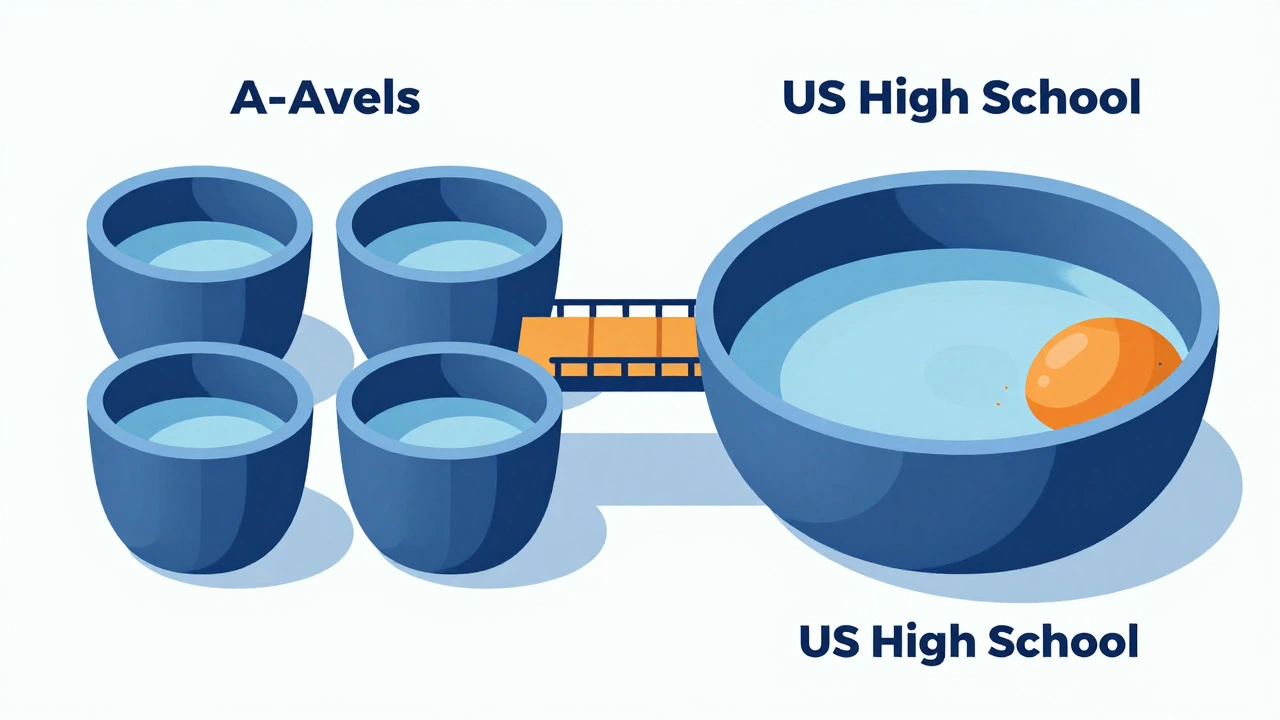
To understand the equivalency, you first need to grasp why the systems clash. The British education system pushes students toward early specialization. By the time you finish Year 12, you are typically studying just three or four subjects in extreme depth. This creates experts in specific fields but leaves gaps in general knowledge.
In contrast, the American high school model emphasizes breadth. Students take a wide variety of classes-history, science, math, arts, and electives-throughout their four years of secondary education. When they arrive at university, they are expected to explore different disciplines before declaring a major. This fundamental difference means US admissions officers cannot simply look at your A-level grade and say, "This equals 60 college credits." They have to evaluate whether you have met their core academic requirements.
How US Universities View A-Level Grades
While there is no official government conversion chart, most US institutions use internal guidelines to place international applicants. Generally, an A-level grade of A* or A is considered exceptional and competitive for Ivy League schools and other top-ranked universities like Stanford or MIT. A B or C is usually seen as solid and acceptable for many state universities and private colleges, provided the rest of your application is strong.
| A-Level Grade | US GPA Approximation | Admission Competitiveness |
|---|---|---|
| A* | 4.0 (Weighted) | Highly Competitive (Ivy League / Top Tier) |
| A | 3.9 - 4.0 | Very Strong (Top 50 Universities) |
| B | 3.3 - 3.7 | Good (Mid-Tier State & Private Colleges) |
| C | 2.7 - 3.2 | Acceptable (Many Regional Colleges) |
| D/E | Below 2.7 | Limited Options / Community College Pathways |
It is important to note that these GPAs are estimates. US schools calculate their own weighted GPAs based on course rigor. An A in Physics A-level carries more weight than an A in a less demanding subject. Admissions officers look at the context of your school's grading history as well.
A-Levels vs. AP Exams: The Real Comparison
If you want a concrete metric for what your A-levels are worth in terms of college readiness, look at the Advanced Placement (AP) program. AP exams are standardized tests offered by the College Board that measure college-level knowledge. Many US students take AP courses during high school to earn potential college credit.
Most universities consider an A-level grade of A or A* to be roughly equivalent to scoring a 5 on the corresponding AP exam. A B or C on an A-level is often viewed as similar to a 3 or 4 on an AP test. This equivalence matters because it because many US colleges grant actual college credits for high AP scores. While policies vary wildly, some universities may grant credit for A-levels, though it is less common than with APs. You must check each university's transfer credit policy individually.
Do You Need the SAT or ACT?
This is the biggest hurdle for UK students applying to the US. Because A-levels do not cover the broad range of subjects required by US high schools, many universities require standardized testing to verify your proficiency in areas you didn't study, such as English literature or general mathematics.
For the 2025-2026 cycle, many top universities have moved to "test-optional" policies due to lingering effects from the pandemic, but this is changing. Schools like MIT, Princeton, and Yale have reinstated mandatory SAT or ACT requirements. Even if a school is test-optional, submitting strong scores can help contextualize your A-level results, especially if you studied subjects that don't align perfectly with your intended major.
- SAT: Focuses on evidence-based reading and writing, and math. It is generally preferred by East Coast universities.
- ACT: Includes a science section and is often favored by Midwest and Southern universities.
If you studied Mathematics A-level, you likely won't need to worry about the math portion of the SAT. However, if you did not study English Literature, the reading section might feel unfamiliar. Treat the SAT/ACT as a bridge to prove your general academic ability beyond your specialized subjects.
Subject Requirements and Gaps
US colleges have specific prerequisite requirements for admission. For example, most universities require four years of English, three years of science, and two years of a foreign language. If you focused heavily on STEM subjects for your A-levels, you might lack the required humanities credits.
Admissions officers will look at your GCSE results to fill these gaps. Your GCSE grades in English Language, History, or Geography can demonstrate that you have the foundational knowledge required. Make sure your transcript clearly shows these earlier achievements. If you are missing key subjects, you might need to take additional coursework or explain your educational path in your personal statement.

The Application Process: Common App vs. UCAS
Applying to US universities is fundamentally different from using UCAS. Instead of choosing five preferences, you can apply to dozens of schools. You will likely use the Common Application platform, which allows you to submit one main application to multiple institutions.
The essay component is also distinct. While UCAS asks for a personal statement focused largely on academic interest, US applications ask holistic questions about your personality, leadership, community involvement, and extracurricular activities. They want to know who you are as a person, not just a student. Use your essays to highlight experiences outside the classroom, such as sports, volunteering, or part-time jobs.
Financial Considerations and Scholarships
Studying in the US is expensive. Tuition fees for international students can range from $20,000 to $60,000 per year, plus living costs. Unlike the UK, where tuition is capped, US prices are market-driven. However, merit-based scholarships are available for high-achieving A-level students. Some universities offer full-ride scholarships based on academic excellence, while others provide partial grants.
You should also investigate need-blind admission policies. A small number of elite US universities (like Harvard, Yale, and Princeton) are need-blind for international students, meaning they do not consider your financial situation when deciding to admit you, and they meet 100% of demonstrated financial need. For most other schools, financial aid is limited for non-citizens.
Do A-levels give you college credit in the USA?
It depends entirely on the university. Some institutions grant credit for A-level grades of A or A*, particularly if they match their introductory courses. Others treat A-levels solely as entrance qualifications and do not award credit. You must contact the registrar's office of each specific university to check their transfer credit policy for international qualifications.
Is an A-level equivalent to a US high school diploma?
Yes, completing three or four A-levels is widely accepted as equivalent to a US high school diploma. Most US universities accept A-levels as proof of secondary education completion. However, they may still require you to meet specific subject prerequisites, which you might fulfill via your GCSE results if not covered in your A-level choices.
Do I need to take the SAT if I have A-levels?
Not necessarily, but it helps. Many universities are test-optional, meaning you can apply without SAT or ACT scores. However, top-tier schools like MIT and Princeton currently require them. Taking the SAT can strengthen your application by providing a standardized metric that compares you directly with US applicants, especially if your A-level subjects don't cover all required areas.
How do A-level grades compare to US GPAs?
There is no official conversion, but generally, an A* or A is comparable to a 4.0 GPA, a B is around 3.3-3.7, and a C is approximately 2.7-3.2. These are rough estimates used by admissions officers to gauge academic performance relative to US standards. The rigor of your specific A-level subjects also influences this assessment.
Can I apply to US universities after only taking AS levels?
Some universities may accept you provisionally based on strong AS-level results, but most prefer completed A-levels. Applying with only AS levels limits your options significantly. If you must apply early, ensure you have excellent GCSE grades and strong SAT/ACT scores to compensate for the incomplete secondary education profile.
Write a comment